
The confirmation of charges hearing against former Philippines president Rodrigo Duterte opened on Monday, February 23, 2026, at the International Criminal Court (ICC) in The Hague, the Netherlands, marking a critical juncture in the pursuit of justice for the victims of his controversial “war on drugs” campaign that is said to have led to the extrajudicial killings of thousands of people.
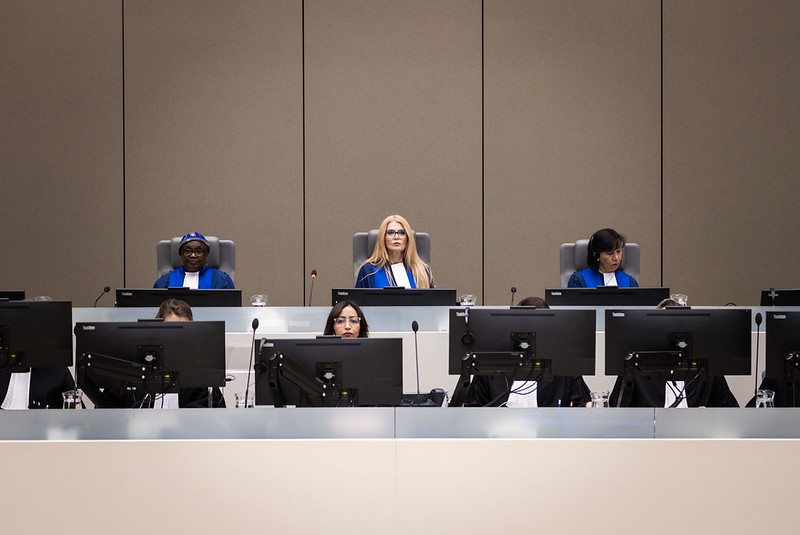
Duterte was not present in the courtroom, having been granted permission to be absent under the provisions of the Rome Statute and ICC Rule 124. Pre-Trial Chamber I judges Iulia Antoanella Motoc (presiding), Reine Alapini-Gansou, and Socorro Flores Liera, have expressed satisfaction that the former president understands the consequences of his absence.
The prosecution opened the hearing, outlining its allegations that Duterte is criminally responsible for multiple counts of murder and attempted murder as crimes against humanity. ICC Deputy Prosecutor Mame Mandiaye Niang said Duterte, 80, was an indirect co-perpetrator in a “widespread and systematic” campaign of killings by the Davao Death Squad (DDS) spanning the period from November 2011 to March 2019, covering both his tenure as Davao City mayor and as president of the Philippines.
Niang presented three counts of murder and attempted murder based on 49 incidents involving 78 victims, including children, noting that these figures represent only a fraction of the total casualties.
“The first of three counts against Duterte concerns his alleged involvement as a co-perpetrator in 19 murders carried out between 2013 and 2016 while he was mayor of Davao City. The second relates to 14 murders of so-called ‘high value targets’ in 2016 and 2017 when he was president. The third charge covers 43 murders committed during ‘clearance’ operations of lower-level alleged drug users or pushers across the Philippines between 2016 and 2018,” the deputy prosecutor told the court.
Senior trial lawyer Julian Nicholls, leading the prosecution’s submission of merits, emphasised that the focus would be on these 49 incidents, detailing 76 murder victims and two victims of attempted murder.
ALSO READ: Day of reckoning for Duterte for his brutal anti-drug campaign
Journey in search of justice
The victims’ legal representative, Joel Butuyan, underscored the symbolic significance of the case, noting that it “represents the last boat the victims can board to go on a journey in search of justice for their loved ones who were brutally killed upon the orders of Mr Duterte”.
He warned that failing to confirm the charges could leave the victims without any recourse to justice. “If this chamber prevents the boat from sailing by not confirming the charges, the victims will forever be mourned on an island where the nights are filled with the screams and cries for their massacred loved ones.”
He said many victims remain fearful of recounting their experiences due to alleged harassment and intimidation by what he described as “clones” of Duterte. “He converted millions of peace-loving citizens into bloodthirsty disciples who have become converts to the belief that violence and killings are valid solutions to societal problems,” Butuyan said.
About 500 victims have been allowed to participate in the ICC case. Butuyan expressed fears that Duterte’s influence could persist in Philippine politics. “Duterte clones will become an even bigger group that can elect another apostle of impunity as the Philippines’ next leader. If that happens, an even more serious condition of impunity can take place in the Philippines, possibly worse than the orgy of violence that happened from 2011 to 2019, and this time, there would be no ICC to run to for assistance and help,” he said.
The counsel described the long-term consequences of Duterte’s policies on Philippine institutions. “The arrest and detention of Mr Duterte have not stopped impunity in the Philippines. The virus of impunity that he spread all over the country has become a cancer that metastasised, infecting millions of Filipinos,” he said.
“If the chamber confirms the charges, the trial proceedings will produce a historical record of the most bloody period of post-war Philippines history, a duty that the Philippines’ justice system has refused to perform.”
The most bloody period of post-war Philippines history
The defence team, led by Nicholas Kaufman, framed Duterte as a polarising yet popular figure. “… We hope that when you conclude your deliberations, your honours, you’ll dismiss these grievously misplaced and politically motivated charges. We will ask you to send Rodrigo Duterte back to his family, and we will ask you to give back to the Filipino people their Tatay Digong,” Kaufman said.
Acknowledging the former president’s outspoken style, Kaufman described Duterte as “a unique phenomenon” whose rhetoric, while “gung-ho in his ways” and full of “hyperbole, bluster and rhetoric”, was never intended to incite unlawful killings.
He claimed that Duterte’s statements were aimed at discouraging the use of illegal narcotics, not orders to kill. “Rodrigo Duterte’s language was aimed not at suspected drug pushers, as the prosecution would have it, but directly at those poisoning society with their substances, and not, I stress, with lethal intent,” the defence counsel said. “His rhetoric was calculated to arouse fear and obedience, to instil fear in their hearts, and to inculcate a respect for the law in their minds. Nothing more, nothing less. That was his intent, and it was not criminal. He stands by his legacy resolutely and maintains his innocence absolutely.”
The defence further contended that Duterte’s arrest was unconstitutional, accusing President Ferdinand Marcos Jr of reneging on a promise not to cooperate with the ICC. “Rodrigo Duterte was unconstitutionally and unceremoniously hauled off to The Hague. So it is, indeed, the defence’s case that President Ferdinand Marcos Jr set out to neutralise Rodrigo Duterte and his legacy.”
Kaufman also criticised the media and civil society, accusing them of amplifying the negative portrayals of Duterte and claiming that the coverage was sensationalised and politically motivated. “These people descended upon the Philippines to advance an agenda even more lacking in objectivity than that of the media. And heavily funded by tycoons with even grander designs, they print their glossy reports, replete with iconic photographic images of grieving families and dead bodies in rain-swept nighttime crime scenes, all dramatically illuminated with a fluorescent glow of neon,” he said. “Images carefully crafted to shock the conscience and sway the emotions and, I may say, to be used by the prosecutor when they don’t even relate to the charges.”
SEE ALSO: Essa Faal: My experiences in international justice, my hopes and dreams for The Gambia
Hearing must focus strictly on evidence
The defence acknowledged Duterte’s assertive style but maintained that the hearing must focus strictly on evidence. “And since we are in a court of law, it is worth stressing, although I should not have to, the cases are decided on the basis of evidence, not supposition, not rumour, not spicy gossip, and certainly not on the basis of political rhetoric and bluster because, at the end of the day, were it not for those belligerent and controversial speeches, there would have been no impetus to bring the ‘people’s president’ to The Hague,” Kaufman added.
The hearing, which will run until February 27, will determine whether there are “substantial grounds to believe” that Duterte committed the crimes the ICC Prosecutor has accused him of. If the charges are confirmed, in total or in part, the case will be transferred to a trial chamber for the subsequent full trial proceedings. Pre-Trial Chamber I will issue its decision on the confirmation of charges within 60 days after the hearing.
Duterte was arrested, at the ICC’s request, on March 11, 2025, upon his arrival in the Philippines from Hong Kong. He was brought to The Hague on the same day and made his initial appearance before the ICC on March 14, 2025.