
For the families of those lost in the shadows of the “war on drugs” campaign in the Philippines, the distance between the streets of the city of Davao and the courtrooms of the International Criminal Court (ICC) in The Hague, has never felt shorter.
Starting February 23, 2026, a landmark five-day confirmation of charges hearing begins before the ICC’s Pre-Trial Chamber I to determine whether there is sufficient evidence to establish substantial grounds to believe that former president Rodrigo Roa Duterte committed the crimes he is suspected of – crimes against humanity of murder – in the Philippines between November 1, 2011 and March 16, 2019.
According to the document containing the charges from the Office of the Prosecutor (OTP), Duterte is suspected of three counts of crimes against humanity: murders in or around Davao City during the mayoral period by the Davao Death Squad; murders of high-value targets during the presidential period; and murders and attempted murders in barangay clearance operations during the presidential period.
For the thousands of victims of the state-sanctioned murder orchestrated between 2011 and 2019, this hearing is not just a procedural step: It is the first time the global community will get an opportunity to weigh the human cost of a campaign that defined a nation for nearly a decade, as the prosecution, the defence, and the legal representatives of the victims make their oral submissions before judges Iulia Antoanella Motoc (presiding), Reine Adélaïde Sophie Alapini-Gansou, and María del Socorro Flores Liera.
Challenges and delays
The initial confirmation hearing, scheduled to start on September 23, 2025, was postponed after the defence requested an indefinite adjournment of the proceedings, claiming that Duterte was not fit to stand trial. The defence lawyer, Nicholas Kaufman, claimed that Duterte was suffering “cognitive impairment in multiple domains”.
However, the court announced the new date for the pre-trial proceedings on January 26, 2026, after finding that Duterte was fit to take part in the pre-trial proceedings and rejected the defence’s request for an indefinite adjournment.
“Having regard to the relevant legal principles, the medical assessment of a panel of three independent medical experts and all of the relevant circumstances of the case, the chamber was satisfied that Duterte is able effectively to exercise his procedural rights and is therefore fit to take part in the pre-trial proceedings, which are thereby resumed,” the court said in a statement.
ALSO READ: East Africa and the Horn: A region stretched by conflict and repression
On February 13, 2026, Pre-trial Chamber I issued a ruling on the second decision on victims’ participation and legal representation, authorising 500 additional applicants to participate as victims at the confirmation stage, bringing the total number to 539.
Joel Butuyan and Gilbert Andres, as well as Paolina Massidda of the ICC’s Office of Public Counsel for Victims, were appointed as common legal representatives for the authorised victims.
The allegations against Duterte
Once the most powerful man in the Philippines, the 80-year-old former president and founder of the Davao Death Squad (DDS), now stands on the edge of a legal precipice.
The allegations brought against Duterte span his time as mayor and vice-mayor of Davao City, as well as his national presidency, specifically covering the period from November 1, 2011, to March 16, 2019.
He is accused of murder and attempted murder committed in the context of the “war on drugs” campaign.
Estimates of the death toll during Duterte’s presidency vary. National police put the figure at more than 6,000, while human rights groups have said it is as many as 30,000.
According to prosecutors in the ICC, at least 19 persons, allegedly drug pushers or thieves, were killed by members of the DDS in various locations in or around Davao City, and at least 24 persons, allegedly criminals, such as drug pushers and thieves, or drug users, were killed by or under the supervision of members of the Philippines’ law enforcement, sometimes with the assistance of persons who were not part of the police, at various locations in the Philippines.
Duterte has long insisted he instructed police to kill only in self-defence and has always defended the crackdown, repeatedly telling his supporters he was ready to “rot in jail” if it meant ridding the Philippines of illicit drugs.
The OTP applied for an arrest warrant against Duterte for the crimes against humanity of murder, torture and rape, on February 10, 2025. Pre-Trial Chamber I found reasonable grounds to believe that the former president was individually responsible as an indirect co-perpetrator for the crimes against humanity.
The chamber found that there was an attack directed against a civilian population pursuant to an organisational policy while Duterte was the head of the DDS, and pursuant to a state policy while he was the president of the Philippines. It also found that there were reasonable grounds to believe that the attack was both widespread and systematic over a period of several years and resulted in thousands of deaths.
“Based on the material before it and the aforementioned findings, the chamber further finds reasonable grounds to believe that Mr Duterte acted with intent and knowledge within the meaning of Article 30 of the Statute in relation to the crime found to have been committed,” the court said.
“The chamber infers his knowledge and intent from, inter alia, his alleged conduct of establishing the DDS and the National Network and controlling them, together with his co- perpetrators; instructing and supporting the city and nation-wide extrajudicial killings of alleged criminals; his public statements accepting responsibility for the killings committed pursuant to the state policy; supplying necessary equipment to implement the attacks; assuming responsibility for the attacks; and promising the police officers and hitmen immunity from prosecution.”
His arrest warrant was issued, in secret, on March 7, 2025, and was made public on March 11, 2025. The next day, Duterte was surrendered to the ICC after being arrested at Manila airport by the authorities of the Republic of the Philippines.
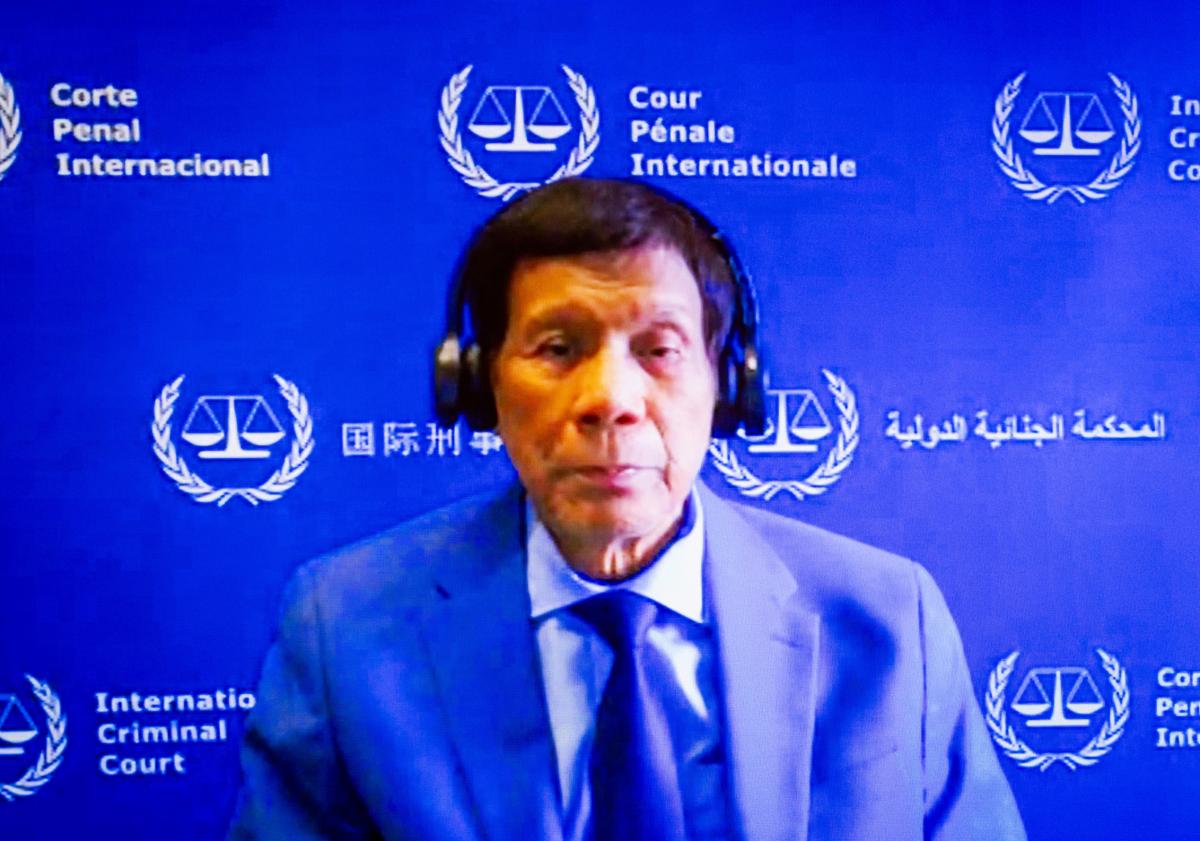
He initially appeared in court via video link on March 14, 2025.
What happens next
After the conclusion of the hearings on February 27, Pre-Trial Chamber I will issue its decision on the confirmation of charges within 60 days. If the charges are confirmed, in total or in part, the case will be transferred to a trial chamber for the subsequent full trial proceedings.
For many of the families that have waited more than a decade for justice, the hearings in The Hague represent not only a legal turning point but also a moment of acknowledgement from the international community.
For the first time, judges will publicly examine the violence that defined an era and consider whether the former president should stand trial for crimes against humanity.
According to a report by the World Organisation Against Torture (OMCT), ICC’s involvement in Duterte’s case signals the dawn of a “light of justice”.
“This is a crucial first step toward achieving justice, especially for the families of victims who have endured years of impunity under his bloody ‘war on drugs’,” the Executive Director of OMCT’s partner organisation, Children’s Legal Rights and Development Centre (CLRDC), Rowena Legapsi was quoted as saying on March 12, 2025.
“It brought back haunting memories of the faces of countless extrajudicial killing victims –especially the innocent children whose deaths we documented. I remember the deep injustice felt by the families we comforted as they tearfully shared their stories. I hope to finally walk side by side with these families as we see the light of justice.”