

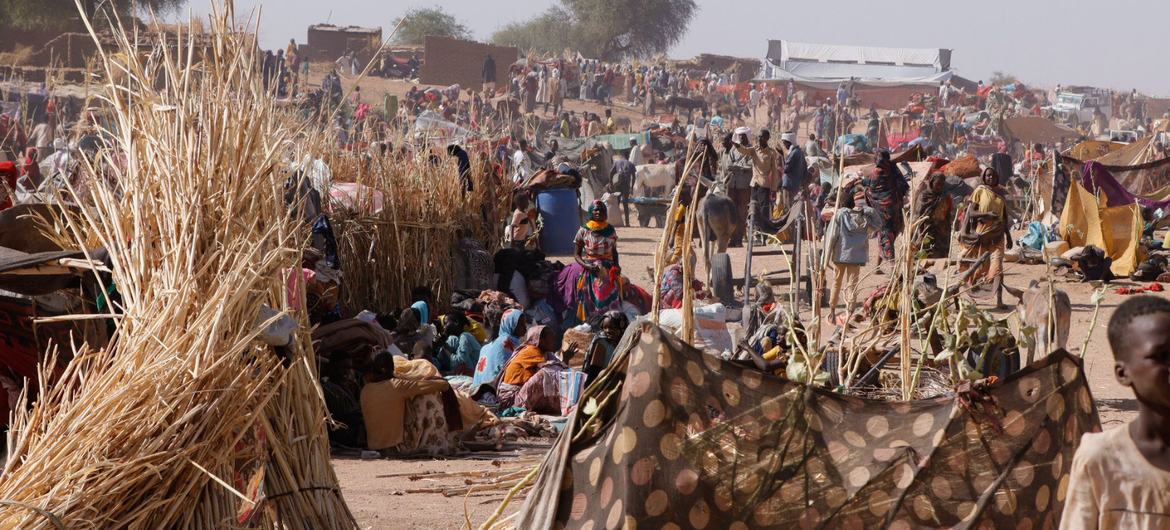
Before the horrors of Sudan’s war erupt in flames or gunfire, the first warning is the silence.
According to Sudanese journalist Enaam Alnour, “Before the houses burned, silence came first. An unnatural silence across the whole city.”
She described how motorbikes moved slowly through neighbourhoods in El Geneina. Men on horseback scanned the streets “as if preparing for something brutal.” Smoke rising from southern districts became a language of its own.
“We learned to read the smoke, which areas had fallen, which roads were no longer safe, and who would be next,” Alnour told Journalists For Justice (JFJ) during an interview in February 2026, during a Whatsapp interview, when she answered questions shared with her.
The day smoke rose from her own home, she realised the war was no longer just a story she was reporting on; it was now consuming her life.
“The smell of burning was no longer news; it was the smell of my life being erased,” she said. “In that fire, I did not lose walls alone; I lost an entire memory.”
She lost her notebooks, photographs, the laughter that once filled the rooms, and her brother.
“From that moment, the fire became a dividing line in my life: before the home and after it, before his presence and after his absence.”
Her personal devastation mirrors an unfolding national disaster as Sudan’s latest war enters its third year. For decades, the Eastern African country has been synonymous with war, genocide, sexual violence, and state-sponsored ethnic cleansing, best symbolised by the tragedy of Darfur. But as the conflict between the national Sudanese Armed Forces (SAF) and the rebel Rapid Support Forces (RSF) continues to escalate, experts have warned that the horror has not only returned; it has metastasised.
“What makes this crisis uniquely severe is the combination of nationwide warfare, massive displacement, and systematic abuse,” Allan Ngari, the Africa Advocacy Director at Human Rights Watch (HRW), said.
Speaking with the measured gravity of someone who has examined too many conflicts, Ngari noted that Sudan’s war has swallowed the country’s heart. “Unlike past conflicts that were largely confined to Darfur or peripheral regions, this one has devastated the capital. Khartoum now is a bombshell. It does not look like the city it once was,” the HRW official told JFJ.
For Darfur, civil war is not a new tragedy; It is the subject of the cases in the Darfur situation at the International Criminal Court (ICC) in The Hague. In December 2025, Janjaweed militia leader Ali Muhammad Ali Abd-Al-Rahman, also known as Ali Kushayb, was sentenced to 20 years in prison after being convicted of 27 counts of war crimes and crimes against humanity committed in the Darfur region more than two decades ago.
The conflict leading to the jailing of the Janjaweed leader lasted from 2003 to 2020 and was one of the world’s gravest humanitarian disasters. Now, only six years after the end of that crisis, Darfur and other areas in Sudan are once again the key battlegrounds for another civil war, this time between the SAF and the RSF.
From the outskirts of El Fasher to the dusty border crossings into Chad, testimonies collected by HRW researchers paint the same bleak picture. “People had nothing when they fled,” Ngari, describing the escape of survivors from Darfur to Chad. “But even that nothing was taken away from them.”
ALSO READ: East Africa and the Horn: A region stretched by conflict and repression
In December 2025, HRW teams interviewed families that had escaped El Fasher after surviving repeated rounds of attacks and looting. Many have been displaced more than once. Some had walked for days without food after RSF-aligned fighters torched their shelters. “Their lives have been uprooted so many times,” Ngari said. “It is devastation layered on devastation.”
In its World Report 2026, released in January, HRW classified the situation in Sudan as the world’s largest displacement crisis, with more than 11.8 million people forced from their homes, as of September 2025, including 7.4 million internally displaced and 4.2 million fleeing to neighbouring countries. Even children have not been spared. The human rights group said no children have been immunised throughout the country. Hospitals are in ruins after months of bombardment by both RSF and SAF.
Alnour witnessed this desperation first- hand when she fled El Geneina.
“I saw mothers carrying one child while leaving another stumbling behind them because they did not have the strength to carry both,” she said. “Every step was a calculation between two forms of death.” Families paused at crossroads, weighing whether to hide and risk hunger or continue and risk gunfire. Women faced degrading searches at checkpoints. People walked past bodies lying on the roadside, lives lost mid-escape.
“In that short geographical distance, people lived an entire lifetime of terror, as if the road itself had turned into an open grave testing the human will to hold on to life despite everything,” Alnour said. “People walked beside death as if it had become part of the journey. On the road from El Geneina to the border, I saw many bodies lying along the way, silent witnesses to those who could not complete the journey.”
Starvation in Sudan is not an accident; it is a weapon
Across Sudan, the collapse is total. Homes burned. Hospitals gutted. Farms abandoned. Markets destroyed. Children growing up in displacement camps where education has disappeared and hunger is constant. Inside the wreckage, survivors describe a life defined by trauma, reduced to nursing the physical and emotional wounds of sexual violence and the struggle for safety, care, and food.
Humanitarian corridors, where they exist, are dangerous pathways filled with checkpoints, ambushes, and obstruction. Even aid convoys are routinely blocked by the RSF.
Ngari said starvation is widespread and deliberate. “There has been no farming since the conflict began. Fields were abandoned, harvests were looted, and safety is nonexistent. Where food exists, it is inaccessible. Where aid is available, it is blocked.”
He called the crisis “a weapon.”
Alnour saw this weapon manifest long before she left her home.
“Food didn’t disappear; it became out of reach,” she said. Markets were emptied and movement became deadly. But what broke her was the hunger on children’s faces. “You see it first in their eyes. They follow any piece of bread. The silence of children is the first sign.” Mothers diluted food with water to make it last another day. “Hunger became humiliation,” she said. “As if the war had decided to exhaust people slowly.”
Both warring parties have obstructed aid convoys. SAF routinely delays visas and movement permits for humanitarian teams, while RSF fighters loot warehouses and besiege supply trucks. According to Ngari, under international humanitarian law, such obstruction can constitute a war crime when it is systematic and causes grave suffering. “The threshold is crossed when obstruction is deliberate, widespread, and harms civilians,” he explained.
Sexual violence and the plight of women survivors
Perhaps the darkest shadow cast by the conflict is the surge in conflict-related sexual violence.
“The levels of sexual violence against women and girls are at an all-time high,” Ngari said. HRW and local Sudanese groups have documented widespread rape, gang rape, abductions, and sexual slavery, particularly in Khartoum, Omdurman, Darfur, and areas controlled by RSF and allied militias. Emergency response rooms, once lifelines for survivors seeking post-exposure prophylaxis and psychosocial support, are collapsing. Kits are scarce. Clinics have been destroyed. Many survivors must choose between silence and the risk of death on the journey for help.
For men and boys, their experiences are even more hidden. “We have accounts of sexual violence against men and boys,” Ngari said. “But due to stigma and fear, cases are vastly underreported.”
Verification now relies on survivor testimonies from refugees in neighbouring countries, remote interviews, and satellite imagery that captures the destruction of communities where abuses occurred. “It is a novel way to monitor what is happening,” Ngari admitted. “But it is what we have left when access is almost impossible.”
Stella Ndirangu, an international human rights lawyer and transitional justice practitioner said the sexual violence unfolding across Sudan is not only widespread but also profoundly dehumanising. She recalled the story of a woman from El Geneina in West Darfur who fled with her children during an attack. “She lost one child on the way,” she said. “She had to leave her son behind so that she could rescue her other children as they continued walking toward the Chad border.”
READ: Duterte confirmation of charges hearing opens at the ICC
The story also illustrates the extraordinary resilience and courage of many Sudanese people who have lived through highly traumatic situations. After eventually crossing into Chad, the woman began volunteering in safe houses, helping other survivors. “Now she serves as a community leader and a champion,” Ndirangu told JFJ.
Yet for most survivors, speaking about sexual violence is impossible.
Ndirangu stated the silence is not a sign of weakness but a survival tactic. “Some of the silence is for self-preservation. Even in neighbouring countries, there have been reports of infiltration by people aligned to the warring parties.” Fear follows the victims even across borders. Stigma is another wall.
“Not everyone who fled has undergone sexual violence, and the ones who have often fear the stigma within their own communities,” she said. Some women choose silence to protect their families. Others remain quiet because husbands or relatives have also endured the violence of displacement. “The woman continues to carry the burden because of those fears.”
Alnour echoed Ndirangu’s sentiments, saying the harshest thing she witnessed from survivors of sexual violence was not only what happened to them, but their silence afterwards. “The silence was not weakness; it was a means of survival. Many of them would begin to speak, then suddenly stop, look down, and say, ‘Just write that we suffered.’ It was as if words had become dangerous. Their silence is not emptiness; it is a long scream the world does not hear.”
She said many women carried invisible wounds. Some crossed borders physically alive but emotionally trapped in the places where they were violated. Others became the sole protectors of entire families.
“I am haunted by the stories of women who war forced to become everything at once: mother and father, provider and protector, witness and survivor. Women who woke up one day to find their husbands killed or missing, and they now had to lead entire families into the unknown,” she said. “War did not give them the luxury of full mourning; it imposed on them the need to keep moving, to manage fear, and to hide their brokenness so those behind them would not collapse. They carried their families the same way they carried memory, with a double weight unseen in headlines, yet written every day in the silent lines of their faces.”
For those still in Sudan, the situation is even more dire. The collapse of the health system has turned sexual violence into a prolonged sentence of pain. “Women are not able to access services on time,” Ndirangu said. Many survivors cannot receive emergency care to prevent pregnancy or infection. Others suffer untreated injuries from the brutality of rape. “It is like a death sentence for these women. They are left with additional illnesses that cannot be treated because the whole system has collapsed.”
Ndirangu described the global response to Sudan’s crisis as being disastrously inadequate. She warned that the world has not grasped the full scale of the calamity. “This is the most catastrophic humanitarian situation in the world, yet the response is lacklustre,” she said, arguing that any meaningful intervention must begin with ending active hostilities. “A ceasefire is the most urgent thing. Aid cannot flow unless the guns fall silent. Sudan needs a quick political solution to return to the path of transition. Only then can people start recovering.”
Civilians and human rights defenders alike face danger
Many human rights defenders have been killed, targeted, or forced into hiding by both SAF and RSF. But according to Ndirangu, the biggest threat is the collapse of funding. “When the US government cut aid, many of the community groups running emergency rooms and mutual aid networks shut down,” she explained.
These groups had replaced both government services and absentee humanitarian agencies. Their loss has left a dangerous vacuum. “These local groups are the last bastion of hope,” she said. “They must be supported because they are keeping communities alive.”
For Ndirangu, the message is urgent and unambiguous; if the world fails to support those holding Sudan’s last threads of humanity together, the consequences will be irreversible. “Even if we resolve the conflict, there must be people still standing who can rebuild Sudan. That will only happen if communities are supported now.”
On February 27, 2026, the United Nations (UN) reported that nearly 34 million people in Sudan would require humanitarian assistance during the year, making this the “highest number of people in need anywhere in the world”.
“Sudan, as you know, the conflict in that country has pushed humanitarian needs to extraordinary levels,” UN spokesperson Stephane Dujarric said at a news conference during an informal meeting of the General Assembly in the Trusteeship Council Chamber. “Our humanitarian colleagues tell us that nearly 34 million people will require aid in 2026…This year, the humanitarian community is calling for US$2.9 billion to reach more than 20 million people facing the most catastrophic needs.” He added that the funding will help to provide food, clean water, nutrition, health care, protection, and education services.
Dujarric also warned that aid workers continue to “face grave dangers” and said that at least 92 of them, mostly Sudanese, have been killed, injured, kidnapped or detained, with more than 65 attacks on health care workers and patients.
The World Food Programme (WFP) said it urgently needs US$700 million to continue its operations in Sudan from January to June 2026. It is estimated that 21.2 million people, 41 per cent of the population, are facing high levels of acute food insecurity, according to the latest Integrated Food Security Phase Classification.
Sudan’s crises are mounting
Sudan’s crises are not new. They are accumulations, each war built on the ruins of the last, each unpunished crime opening the door to the next.
Ngari described a pattern that feels painfully familiar. “We are documenting mass killings, summary executions, and ethnically targeted violence by RSF-aligned forces,” he said. “Homes, markets, and camps for displaced people have been burned. There is widespread looting. There is sexual violence. The patterns resemble earlier atrocities in Darfur.”
HRW said it believed some of the violations may amount to war crimes and crimes against humanity, echoing the atrocities that brought global attention to Darfur in the early 2000s.
Amnesty International has recorded testimonies from some of the 260,000 civilians who were still trapped in El Fasher on October 26, 2025, the day the city fell, and the ordeal they suffered.
One victim said he only survived because he pretended to be dead: “The RSF were killing people as if they were flies. It was a massacre. None of the people killed that I have seen was armed soldiers.”
Another survivor narrated how the RSF killed elderly and sickly men in cold blood. “They were enjoying it, they were laughing,” he said. While in captivity, he witnessed a soldier filming the execution of one man during a call with the victim’s relatives. Amnesty said the man was one of three detained brothers whose family had not yet paid a ransom to secure their release. “They shot one in the head on camera and told them [his relatives]: ‘Look, if you don’t send the money as soon as possible, the other two will be killed and you won’t even be told that they have been killed’,” the survivor told Amnesty.
Ngari traced the pattern of violence with clinical clarity. “Sudan has had decades of unresolved atrocities,” he explained. “The judiciary is politicised or destroyed. Military elites dominate political life. Peace deals repeatedly trade justice for temporary calm.”
The result is predictable. “The message is that serious abuses can continue without consequences,” he said.
Nowhere is this clearer than in the limits of the ICC. The court’s jurisdiction covers only Darfur, as dictated by a 2005 UN Security Council resolution. Crimes committed in Khartoum, the Kordofans, and other regions fall outside its mandate.
“The ICC cannot prosecute atrocity crimes happening across the rest of Sudan,” Ngari noted. “Extending jurisdiction is impossible because Russia and China would veto it.”
This leaves victims in much of the country with no clear path to justice.
Sudanese groups are now exploring universal jurisdiction cases in East Africa, hoping countries like Kenya or Uganda might prosecute atrocity crimes committed abroad. However, meaningful progress remains distant.
Ngari was blunt about the barriers. “The primary bottleneck is political will,” he explained. “The legal framework exists in several countries, but governments are hesitant to antagonise the generals. Without political commitment, the cases cannot move forward.”
The headache of justice
According to him, long-term justice will require a hybrid court or an independent international tribunal for Sudan, like the models used in Sierra Leone and Cambodia. But this cannot happen until the war ends.
The African Union and the Intergovernmental Authority on Development (IGAD), institutions created to safeguard peace on the continent, have struggled to mount a coordinated response to conflicts. Geopolitical fractures, shifting alliances, and influence from powerful external actors have slowed interventions.
READ:
Essa Faal: My experiences in international justice, my hopes and dreams for The Gambia
“There is an absence of coordinated efforts from African institutions,” Ngari said. “It is not just slow; it is fragmented.”
Sanctions imposed by the United States and the European Union have targeted key RSF and SAF commanders, but their impact on the ground is limited. “Sanctions matter symbolically,” Ngari noted, “but they have not meaningfully changed behaviour.”
For the millions caught in Sudan’s war, each day is a test of survival. Families on the move. Children buried under rubble. Women assaulted as a form of warfare. Communities wiped out because of their ethnicity. A nation starving while aid trucks sit idle at borders. The world has called Sudan the forgotten war. For those living it, forgetting is impossible.
When Alnour looks back at the people she left behind, one image haunts her. “A mother waking before dawn, walking long distances without knowing if she will return alive, just to find some flour,” she said. “Safety and food have become a battle.”
She noted that those who remain do not only need humanitarian aid, they need their daily struggle to be seen as an ongoing human story, not merely numbers in reports. “They are living a long war without a ceasefire, where survival itself becomes hard labour, and every temporary moment of calm is a small victory unnoticed beyond the borders of pain.”
Ngari’s message is clear: What is happening in Sudan is one of the gravest crises globally, but it is not inevitable. The Sudan war is the result of choices by those who wage the war and those who watch it.