

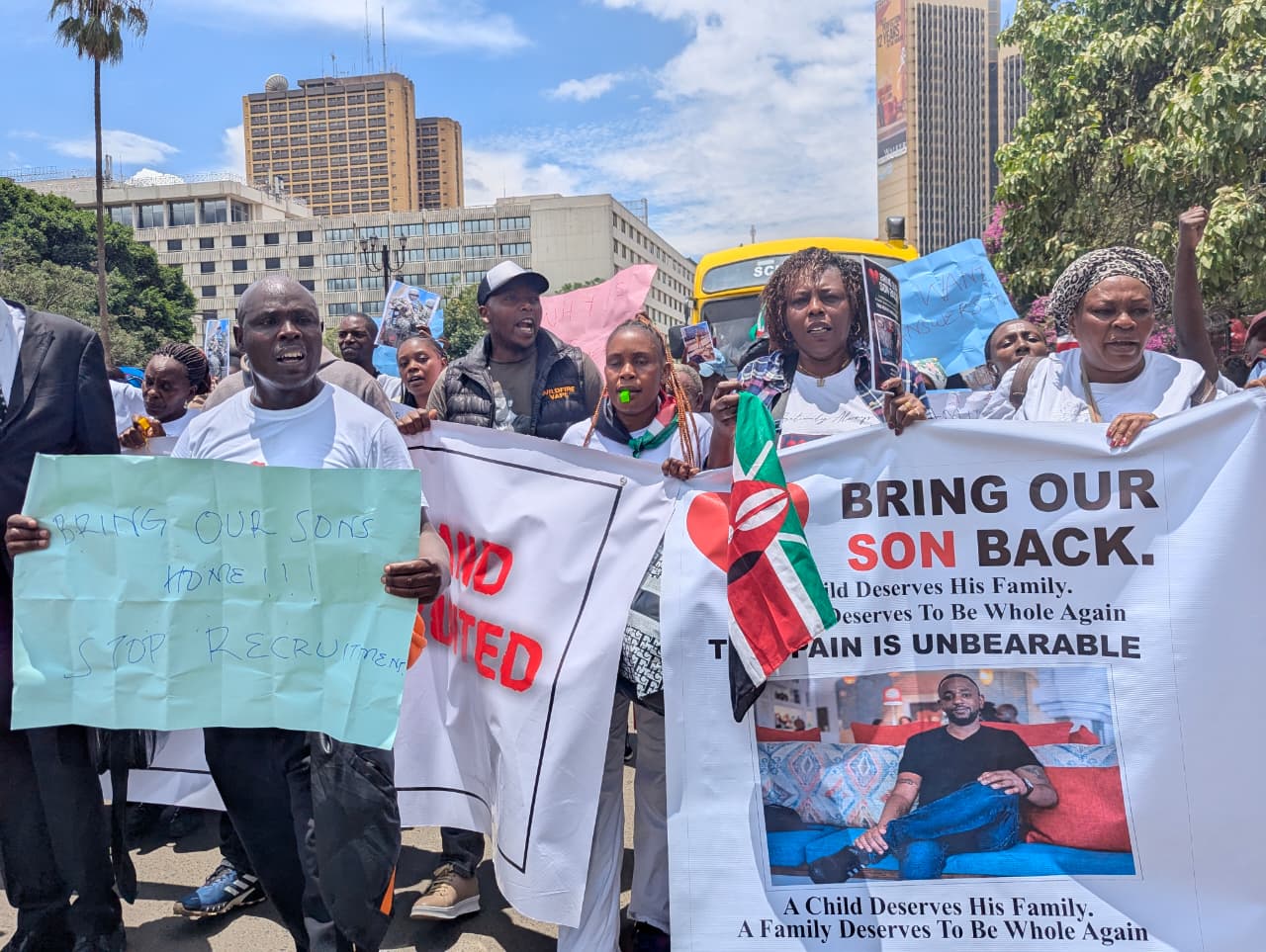
Months after at least 1,000 Kenyan men travelled to Russia expecting jobs and instead landed in military camps and at the war front, their families are haunted by silence and fear, unsure whether their loved ones are dead or alive.
However, they have refused to be discouraged by the wall of silence that has met their enquiries about the fate of their relatives and are determined to find out what has happened to their kin. As part of these efforts, they have organised demonstrations, marching to the Kenyan Parliament and government offices in Nairobi, petition in hand, to get urgent intervention and better information as they seek the safe return of their people, who they claim were coerced into joining the Russian army to fight in Ukraine or are detained in prisoner-of-war camps in Ukraine.
“We respectfully submit that this matter involves human trafficking, forced recruitment, and possible violations of international humanitarian and labour laws, raises serious national security, diplomatic, and human rights concerns, and falls squarely within the constitutional obligation of the Government of Kenya to protect its citizens abroad, as provided for under Article 43 and Article 238 of the Constitution of Kenya,” the petition to the government stated.
The petition, addressed to Prime Cabinet Secretary Musalia Mudavadi, the Ministry of Labour and Social Protection, and the State Department for Diaspora Affairs, claimed that the affected Kenyans were recruited under false promises of employment, then forced into active combat roles in the ongoing Russia-Ukraine conflict. Some are reportedly detained in Ukrainian prisons, while others may have died in the conflict. The families complained that they were forced to act after months of silence, with the Russian embassy declining to provide information and the Kenyan government, through the Diaspora Office, offering limited assistance.
Their petition called for the verification of the status and location of all the affected Kenyans; high-level diplomatic intervention, including presidential engagement if necessary; unconditional consular access; facilitation of safe repatriation; formal engagement with Ukraine to secure the release of the detained Kenyans; and transparent public accountability statements from the Kenyan authorities.
Sharing their stories
For weeks, family members gathered at the Jeevanjee Gardens in Nairobi to share their stories, appeal for intervention, and highlight the ongoing risks their loved ones face. They described encountering repeated dead ends as they tried to contact the authorities, with little progress on confirming the whereabouts or safety of the missing Kenyans.
There is always a quiet sense of frustration mingled with hope during their meetings. Relatives displayed photos of their missing kin, replayed their last conversations, and narrated how they had tried, in vain, to reach out to contacts in Russia and Ukraine. The world may have moved on, but these families are still waiting for their loved ones.
ALSO READ: New ‘military operation’ threatens to escalate South Sudan conflict
At the centre of the families’ pain are months of silence, unanswered calls, and repeated dead ends. The relatives described the circumstances under which their loved ones left Kenya, the promises they were given, and the sudden shift to military training once they arrived in Russia.
Liz Mwaniki was among the first to speak to Journalists For Justice (JFJ). She recounted the last time she spoke with her son, Fredrick Mwaniki. Her voice was steady, but the strain was clear.
“I am looking for my son, Fredrick. He went to Russia in October 2025, and the last time I spoke to him was on November 28, 2025. Since then, his phone has been off,” she said.
Fredrick, 39, travelled to Russia after being promised a job in IT. His mother said she does not know whether the person who facilitated the trip was an individual agent or a company. She is unclear on the details.
“When he arrived, he told me they were informed they had to undergo three weeks of military training before they could start their jobs,” Liz said. “Later, he told me they had been lied to and instead taken to the military, and everything was taken from them. He said he had been forced to join the military.”
According to her, Fredrick warned her that communication might soon be cut off. “He asked me to pray for him, for he had been forced to join the Russian military,” she added. “He has a family. We are all very worried.”
Liz described how her quest to get answers met with indifference and, at times, hostility.
“We went to the Russian embassy, the Red Cross, and the Ministry of Foreign Affairs. At the Red Cross, they directed us to get a report and wait for emails. In other offices, we were chased away. Others ignored us. We just want answers.”
That was the last day I heard from him
Margaret Wairimu, 30, from Kiambu, described a similar ordeal regarding her brother, James Kamau. She accompanied him to the airport on June 28, 2025, the day he travelled to Russia courtesy of a contact made through a friend.
“When he arrived, he told me he was studying the Russian language for about 10 days,” she said. “Later, he said the jobs he had been promised, either driving or cooking, were not available. He said he was forced to join the Russian military.”
Communication between the siblings continued until July 17, 2025, when she received the last message from Kamau. “He told me, ‘Nang’ang’ana tu’ (I am just hustling),” she recalled. After that, silence.
Wairimu did not immediately understand the gravity of the situation. “I did not even know there was a war in Russia until my father told me,” she said.
For years, Kamau had been a migrant worker. He was employed in construction in Qatar and also spent time in Tanzania as a bead worker. Therefore, the opportunity in Russia was not strange to his relatives; it seemed like a favourable prospect for him and his young family.
According to Wairimu, the agent who arranged Kamau’s travel was called Gilbert. “My brother met him several times in Utawala,” she said. “His wife also met him in Nairobi. He said nothing about the military. After my brother disappeared, the agent switched off his phone. We can’t reach him.”
Wairimu said Kamau and a friend who travelled with him were promised a salary of KSh215,000 (about US$1,660) a month. They were also told they would open bank accounts upon arrival in Russia. “He said the account would hold Sh1 million (about US$7,700), with half belonging to them and the rest going to the agent,” she said. “He told us they opened the accounts, but he could not access his.”
The last communication Kamau had with his wife was on July 25, 2025, through a Russian number. “He told her they were in the trenches underground,” Wairimu said. “He said phones were not allowed. After that, we did not hear from him again.”
The family has tried calling several Russian numbers that previously connected them to the men, but those numbers now block their attempts.
READ: Sudan’s forgotten war takes heavy toll on displaced citizens
“He has a one-year-old baby,” she said. “We are living in fear every day. We only want to know if he is alive.”
Kamau’s family held a symbolic burial for him on March 7, 2026, in Mboroti village in Limuru, Kiambu county, after receiving news that he was killed in action.
He told us things were tough
Felista Njoki last spoke to her husband, Samuel Mwaura Wainaina, on October 28, 2025. He had travelled to Russia the month before after being promised work as a mall security officer.
“When he arrived, he was told he had to undergo military training,” Njoki said. “He said they were being prepared for a mission. He did not say what mission.”
Wainaina told her the mission would last only a month, but four months later, she had still not heard from him.
Njoki said her husband was recruited by a Russian woman named Julia. “I do not know where they met,” she said. “He was told he had to join the military or he would not get any job.”
According to an intelligence briefing presented to the Kenyan Parliament on February 18, 2026, more than 1,000 Kenyans have been recruited into the Russian military, many of them lured with promises of high-paying jobs and then redirected to training and combat roles once in Russia or through transit countries such as Turkey and the United Arab Emirates.
Kimani Ichung’wah, the Majority Leader in the Kenyan Parliament, said intelligence reports had confirmed that certain rogue recruitment agents were colluding with some officials in Kenya and Russia to redirect jobseekers into combat roles.
The Ministry of Foreign Affairs had earlier estimated that more than 200 Kenyans were actively fighting for Russia and warned that recruitment networks remained active, with some recruits being injured, going missing, or getting detained. The situation has raised serious concerns in Nairobi about deceptive recruitment practices, the welfare and safety of Kenyan citizens, and potential human trafficking, prompting diplomatic engagement with the Russian authorities and calls for better protection of Kenyan jobseekers abroad.
The attention the case of the missing Kenyans attracted resulted in a long-awaited response from the embassy of the Russian Federation on February 19, 2026, dismissing the claims as “dangerous and misleading propaganda”.
The statement insisted that Russia had not engaged in illegal recruitment of Kenyan citizens into its armed forces.
“At no point in time throughout the ongoing crisis in Ukraine the embassy ever issued visas to Kenyan citizens who sought to travel to Russia with the stated purpose of participating in the Special Military Operation (SMO) in Ukraine. Nor has the embassy been encouraging any Kenyan citizen to do so, let alone colluding with any entities or individuals to coerce or lure Kenyans into participating in the SMO under false pretext,” it said.
However, the embassy pointed out that Russian law allows any foreigner residing legally in Russia to voluntarily enlist in the military.
Families left in limbo
Despite the diplomatic exchanges, the families meeting at the Jeevanjee Gardens say their questions remain unanswered. They are asking for government action that goes beyond mere statements; they want confirmation of the whereabouts and condition of their loved ones.
Liz, Wairimu, and Njoki said the uncertainty is the hardest to bear. They replay their last conversations with their missing relatives endlessly, analysing voice tones, pauses, and words. They reach out to every number that once connected them to Russia. Sometimes, the calls go unanswered. Other times, they are blocked.
“We want to know if they are alive. They should be brought home, dead or alive,” Wairimu said.
The families’ determination has not wavered. They said they would continue to push for answers about the welfare of their kin. They asked both the Kenyan and Russian authorities to acknowledge their responsibility in protecting their citizens.
They continue to meet at the Jeevanjee Gardens, holding on to the photos of their missing husbands, sons, and brothers, holding on to hope.