
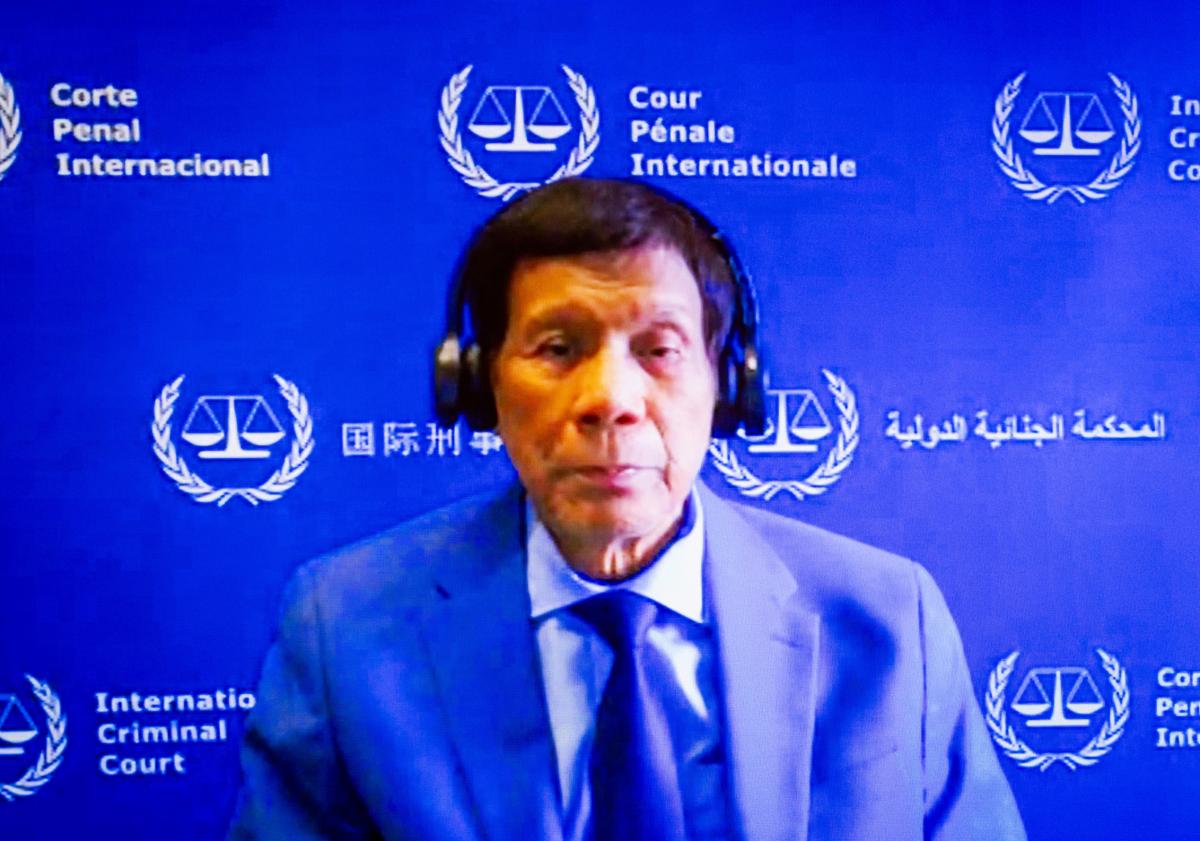
Former Philippines President Rodrigo Roa Duterte is set to face trial at the International Criminal Court (ICC) after the judges “unanimously confirmed all the charges brought against him in connection with his “war on drugs” campaign.
In a statement released on Thursday, April 23, 2026, the ICC said Pre-Trial Chamber I concluded that there are “substantial grounds to believe that Duterte is responsible for the crimes against humanity of murder and attempted murder, pursuant to article 7(1)(a) of the Rome Statute.”
The crimes were allegedly committed as part of a widespread and systematic attack against the people of the Philippines between November 1, 2011, and March 16, 2019, covering both his tenure as Davao City mayor and as president.
The court said judges Iulia Antoanella Motoc (presiding), Reine Adélaïde Sophie Alapini-Gansou, and María del Socorro Flores Liera based their decision on the evidence presented during the confirmation of charges hearing held from February 23 to 27, 2026, as well as the submissions and documents of the parties and participants involved, including participating victims.
Human Rights Watch (HRW) welcomed the verdict.
“The ICC decision to send Duterte’s case to trial opens the door to long-awaited justice for the families of the ‘drug war’ victims and acknowledges their suffering,” said Maria Elena Vignoli, the organisation’s Senior International Justice Counsel.
“Duterte’s trial will send a powerful message that no one responsible for grave crimes is above the law, whether in the Philippines or elsewhere, and that justice will eventually catch up with them,” she added.
The Office of the Prosecutor (OTP) termed the ICC decision a milestone in the efforts to advance accountability for the victims of the alleged extrajudicial killings and other abuses.
“It validates the prosecution’s work in establishing substantial grounds to believe that Mr Duterte bears responsibility for the crimes charged. The Office of the Prosecutor reiterates its unwavering commitment to pursuing justice for victims and affected communities and will continue to take all necessary steps, in accordance with its mandate, to ensure that accountability is achieved without delay,” the OTP said.
The ICC noted that the parties are not automatically entitled to appeal the decision but added that they can request authorisation from the Pre-Trial Chamber to do so.
ALSO READ: Duterte confirmation of charges hearing opens at the ICC
Defence Counsel Nick Kaufman took issue with the Pre-Trial Chamber’s finding that the word “neutralise”, used to define a state or organisational policy, was understood by those involved in the operations to mean to “kill”.
“This is hardly surprising when the whole of the prosecution’s case, as pasted into the concluding paragraphs of the Pre-Trial Chamber’s decision, is based on the uncorroborated statements of self-confessed murderers acting as cooperating witnesses. The credibility of these witnesses was never assessed at confirmation. They will now be excused from prosecution and will most likely be rehoused with new identities at considerable cost to the international community funding the activities of the Office of the Prosecutor,” he explained.
Kaufman promised that at trial, the defence will prove that the aforementioned “state policy” is a “complete fiction”.
“The defence will also show that the evidence of the very same criminal witnesses, so gleefully peddled by the former president’s many detractors, has zero weight,” he added. “The defence will most definitely be seeking leave to appeal the most bizarre and Kafkaesque assertion by the Pre-Trial Chamber that there is no need, and I quote, for ‘the charges to contain unnecessary details that could be too specific and limiting at trial’. In the defence’s opinion, this just shows to what extent the Pre-Trial Chamber was prepared to accommodate the prosecution at the expense of the former president’s fair trial rights.”
During the confirmation hearing last February, ICC Deputy Prosecutor Mame Mandiaye Niang presented three counts of murder and attempted murder against Duterte. They are based on 49 incidents involving 78 victims, including children. He noted that the figures represent only a fraction of the total number of casualties.
Estimates of the death toll during Duterte’s tenure vary. The national police put the figure at more than 6,000, while human rights groups have said it could be as many as 30,000.
Prosecutors said at least 19 persons, allegedly drug pushers or thieves, were killed by members of the Davao Death Squad (DDS) in various locations in or around Davao City, and at least 24 others were killed by or under the supervision of members of the Philippines’ law enforcement, sometimes with the assistance of persons who were not part of the police, at various locations in the Philippines.
Duterte has consistently pushed back against these allegations, insisting he instructed police to kill only in self-defence. He defended the crackdown, repeatedly telling his supporters he was ready to “rot in jail” if it meant ridding the Philippines of illicit drugs.
Trial Chamber
With the charges now confirmed, the ICC Presidency will form a trial chamber composed of three judges other than those who sat on the Pre-Trial Chamber to proceed with the case.
It remains uncertain whether Duterte, 81, will attend his trial, having been granted permission to be absent during the confirmation of charges hearing owing to his failing health. Article 63 of the Rome Statute requires that the accused be present during their trial.
A day earlier, the Appeals Chamber dismissed a bid to throw out Duterte’s trial, saying the court has jurisdiction over the case.
The judges upheld an earlier decision by Pre-Trial Chamber I. The ruling, made on October 23, 2025, found that the court may exercise jurisdiction in the Duterte case over the alleged crimes that were committed while the Philippines was a State Party to the Rome Statute.
The country was a member of the statute for almost eight years from November 1, 2011, until its one-year withdrawal notice took effect on March 17, 2019.
This means the ICC retains jurisdiction with respect to the alleged crimes that occurred in the country during that period, up to and including March 16, 2019.