
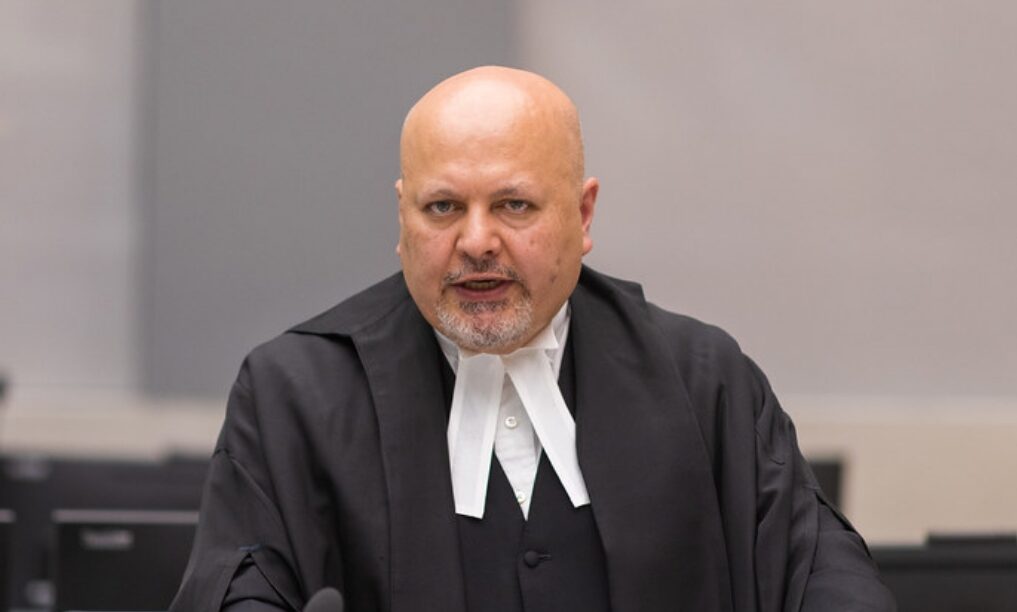
As the Assembly of States Parties (ASP) prepares to determine the fate of suspended International Criminal Court (ICC) Prosecutor Karim Khan during a special session scheduled for July 24, 2026, the official has rejected calls for his resignation, insisting that he “will not surrender to bullying, to a coordinated media or public campaign by some, or to political manoeuvring”.
Responding to questions from Journalists For Justice (JFJ) on the matter and on some of the views expressed by various stakeholders in the international criminal law community, Khan warned that his resignation would set a dangerous precedent, allowing “allegations, publicity and pressure” to remove an independent prosecutor.
“Resignation in these circumstances would not be an act of honour. It would be to succumb to the enormous pressure directed against me and the unlawfulness of so many of the decisions that underpin this matter,” he explained.
The Prosecutor questioned the motives of those calling for his early departure rather than waiting for the process to run its course.
In an article posted on his blog in the aftermath of the Bureau’s actions, International criminal law attorney Michael Karnavas advocated the halting of the process in the case against Khan, saying it had crossed the threshold of neutrality and risked impacting the institutional integrity and stability of the ICC.
“That is why, in my view, the most responsible course at this stage would be for Prosecutor Khan to resign rather than allow the matter to proceed to a prolonged political determination before the ASP, which will inevitably prolong uncertainty at the top of the institution,” Karnavas said.
Appearing to prioritise the ICC and the effect the prolonged case involving one of its top officials could have on the institution, he said the matter had reached a point where continuing the process could become a source of vulnerability for the court unless it was stopped.
READ ALSO: Financial woes threaten victims’ hopes for ICC reparations
“The question of resignation should no longer be framed in terms of individual position or entitlement but as a question of institutional responsibility, recognising when the ICC’s interests are better served by closure than by continuation.”
The Rome Statute
He concluded: “The simplest way to avoid a prolonged institutional test is also the most direct: an orderly departure now, rather than an extended contest.”
Khan did not agree with this view. “Ultimately, this matter should be determined through the processes established by the Rome Statute, not through media campaigns, advocacy efforts or public pressure,” he said.
Pointing to the report of the independent three-member judicial panel appointed by the Bureau of the ASP to examine his case, which unanimously found that the evidence presented before it did not establish any misconduct or breach of duty on the part of the Prosecutor, Khan expressed confidence that the ASP would reach the same conclusion.
“I have confidence that the wider Assembly of States Parties, representing the full membership of the court, will consider these matters fairly, carefully and independently and will choose to follow the unanimous conclusion of the judges the Bureau itself appointed.”
International lawyer Chief Charles Taku, who serves as an ICC counsel and is also the traditional leader of the anglophone minority in Cameroon, supported Khan’s resistance to calls for his resignation. He contended that the Prosecutor’s resignation could weaken confidence in international justice and potentially affect ongoing ICC proceedings.
“If he resigns, that will negatively affect the confidence of victims in international justice at the ICC, not because of the court but because of the political pressure on the independent organs of the court through the Bureau,” he explained.
On the observations made by Karnavas in his article, Khan said the lawyer had previously communicated to him that he was “confident the allegations are bogus” and offered his legal expertise and support.
“That history is not insignificant. It demonstrates that Mr Karnavas initially formed a markedly different assessment of these allegations from the one he now publicly advances. Readers are entitled to take that context into account when assessing the weight to be attached to his present commentary,” the Prosecutor said.
“I bear Mr Karnavas no ill will and fully respect his right to express his views. Equally, though, I believe transparency requires that those views be understood in their proper context. The future of the office, the integrity of the court, and the application of due process cannot sensibly be determined by the commentary of any one practitioner, however energetically or persistently expressed.”
Khan reiterated his denial of any sexual relationship with the alleged victim. “I have consistently and unequivocally denied any sexual misconduct and any sexual relationship of any kind, consensual or otherwise, with the individual concerned. I repeat those denials and stand firmly that I have not committed any acts as alleged.”
International legal community
He said he was humbled by the vote of confidence he continued to receive from “a substantial number” of the staff of the Office of the Prosecutor (OTP), whom he claimed expressed confidence in his leadership and supported his return to the office, adding that he was grateful for the confidence of “victims’ representatives and affected communities from Darfur to the Rohingya and beyond”.
The case against Khan and the processes involved in resolving it have divided opinion within the international legal community.
Chief Taku termed the Bureau’s decision to suspend Khan and send his case to the ASP “…a logical outcome of a politically opaque process fuelled by leaks and prejudicial comments skewed towards this predetermined result”.
He argued that the process had been compromised by leaks, political interference, and procedural inconsistencies, adding that confidential submissions, including one by former International Court of Justice (ICJ) Judge Abdul Koroma, were leaked and used in what he described as a smear campaign against Khan.
READ: New wave of military coups worsens democracy crisis in West Africa
New wave of military coups worsens democracy crisis in West Africa
Chief Taku criticised the Bureau for failing to investigate or condemn the leaks, address allegations of bias among some of its members, or explain why it disregarded the findings of the independent panel of judges it had appointed. He claimed that the Bureau had decided to bypass the ICC’s Independent Oversight Mechanism (IOM), warning that its actions risked creating a “Karim Khan exception” that could undermine the court’s institutional framework and set a problematic precedent for future cases.
In reality, the IOM had no opportunity to conduct a formal procedure as the alleged victim declined to file a formal complaint, which would have allowed the Mechanism to act.
Alix Vuillemin, the Women’s Initiatives for Gender Justice Executive Director, noted that the Bureau’s decision acknowledged the matter was serious enough to be brought before all 125 ASP members.
“Behind every procedural development in this case, there are real people, including a woman who reported very serious harm, colleagues who supported her, and an institution under strain,” she told JFJ. “We urge the assembly to see this through with legal rigour, fairness, due process, and the human dignity this process has sometimes lacked.”
Sergey Vasiliev, a professor of international law at the Open University of the Netherlands, asked why the Bureau did not expressly state that its investigation had found evidence of serious misconduct on the part of the Prosecutor, although the fact that it chose to refer the matter to the ASP implied this.
“Still, it’s unclear why the Bureau chose not to articulate this finding, especially since the decision remains confidential,” Vasiliev tweeted.
He also highlighted the fact that the Bureau’s statement confirmed that its decision was based on the “underlying evidence” and “the advice of an ad hoc panel of judicial experts”.
The professor argued that this meant that the Bureau member states conducted their own independent evaluation of the evidence and ultimately chose to depart from the panel’s conclusion.
He also noted that the Bureau published its conclusions “at the eleventh hour”, while the decision itself and its supporting documentation remained secret.
Standard of proof
Purna Sen, a former Special Adviser on Working Climate to Khan, a role that encompassed sexual harassment, welcomed the decision, calling it an “action towards accountability”, while drawing a careful legal distinction.
Noting, in a post on LinkedIn, that reports suggested the advisory panel of judges had applied a standard of proof of beyond a reasonable doubt, which was not met, she pointed out that, “Every lawyer, and many others, knows this is not the same as saying that the allegations were false.”
Sen, who described herself as a supporter of the court, said the reputational damage was immense. “Such serious allegations against the man at the helm of the prosecution of abusers will inform how the court is now seen.”
She added that she was “dismayed at how the victim-survivor has been treated in much media coverage,” and said the case had “undoubtedly done harm both to individuals and the court.”
In its statement announcing its referral to the ASP, the Bureau emphasised that Khan’s suspension was “not an indication of the final outcome”.
It explained that its assessment drew from a report by the United Nations Office of Internal Oversight Services (UN-OIOS), the underlying evidence, advice from an ad hoc panel of judicial experts, and written submissions, and added that its decision and related documentation would remain confidential. The Bureau called for due respect for the privacy and rights of all parties, as well as the integrity of the ongoing process.
The Presidency of the ICC urged the ASP to resolve the disciplinary proceedings against Khan “with the highest priority”, warning that the institution’s credibility, its duty to victims, and the well-being of its staff now hang in the balance.
On its part, the OTP said it respected the process and would fully cooperate.
“The office echoes the call of the Presidency of the ASP to protect the integrity of the ongoing disciplinary process, and to respect the privacy and rights of all involved parties,” it said on June 9, 2026.
It also acknowledged its duty of care to the ICC personnel, saying it remained “acutely aware” of its obligations, particularly to those directly affected, and would continue to prioritise a safe and respectful workplace.
Under ASP rules, any finding of serious misconduct would require a two-thirds majority of states present and voting. A second vote on removal would then require an absolute majority, which is 63 of the 125 member states.
Allegations of sexual misconduct against Khan emerged in May 2024, but the ICC’s IOM closed its investigation when the victim declined to participate. The probe was later revived and transferred to the UN-OIOS.
The allegations against Khan surfaced publicly after he announced his decision to seek arrest warrants against Israeli Prime Minister Benjamin Netanyahu and former Defence Minister Yoav Gallant over alleged war crimes and crimes against humanity linked to the Gaza conflict. There has been speculation about whether the developments were connected, an assertion Khan has rejected, maintaining that decisions in the Palestine investigation were based solely on the evidence before the court.
Crimes against humanity
That inquiry ran from November 2024 to December 2025, generating more than 5,000 pages of evidence and testimony.
The findings were delivered to a three-judge panel, which was tasked with advising the Bureau on whether Khan’s conduct amounted to serious misconduct, less serious misconduct, or no misconduct at all.
The panel unanimously concluded that the facts presented in the UN investigation “do not establish misconduct or breach of duty under the relevant framework”.
It will be a major challenge for Khan to attend the special session of the ASP in New York to consider the disciplinary proceedings involving him due to the sanctions the US has imposed on him and other ICC officials, including a travel ban to its territory. Yet, according to Article 46(4) of the Rome Statute, he ought to be present.
“A judge, Prosecutor, Deputy Prosecutor, Registrar or Deputy Registrar whose conduct or ability to exercise the functions of the office as required by this Statute is challenged under this article shall have full opportunity to present and receive evidence and to make submissions in accordance with the Rules of Procedure and Evidence…” the article states.
Former Sudanese president Omar Al Bashir, wanted by the ICC on charges of genocide, crimes against humanity, and war crimes allegedly committed in Darfur, is facing longstanding US sanctions, making travel to the United States effectively impossible. His reported plans to travel to New York to attend the UN General Assembly in 2013 and 2016 failed due to international diplomatic pressure.
On July 2, 2026, the Middle East Eye (MEE) reported that the Bureau of the ASP had changed the voting procedure in Khan’s case by replacing the previously expected two-stage process with a single vote that would simultaneously determine whether he committed serious misconduct and whether he should be removed from office. It cited diplomatic sources.
Khan’s lawyers at Carter-Ruck, who said they were not notified of the changes, criticised the decision, saying it departed from the bureau’s own written procedures, lowered the threshold for a finding of serious misconduct, and raised concerns about due process.
“Altering the rules of a named individual’s case partway through, to his disadvantage and without notice to him, raises the most serious questions of lawfulness and of basic fairness,” the lawyers told MEE.
This article has been updated to include more comments and further clarifications.