

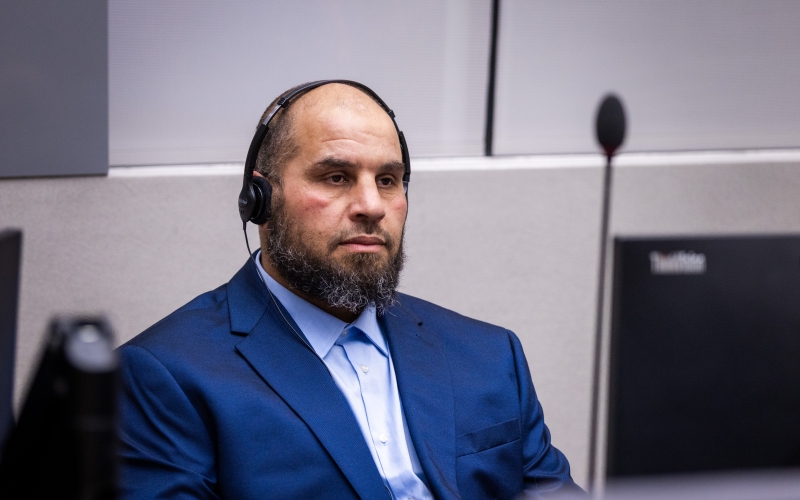
The victims of former Libyan prison boss Khaled Mohamed Ali El Hishri will get their day in court after the International Criminal Court (ICC) unanimously confirmed charges of war crimes and crimes against humanity that the Office of the Prosecutor (OTP) had presented against him, and committed him to stand trial.
Pre-Trial Chamber 1 found that there were substantial grounds to believe that El Hishri bore responsibility for 17 counts of torture, cruel treatment, imprisonment, outrages upon personal dignity and other inhumane acts; rape and other forms of sexual violence; murder and attempted murder; enslavement; and persecution.
The prosecution alleged that the crimes were committed against thousands of individuals who were detained in Mitiga Prison and/or within the Mitiga compound between May 1, 2014 and June 30, 2020, when the Special Deterrence Force or RADA (SDF/RADA), a powerful armed group that dominated western Libya, operated the Mitiga Prison in Tripoli.
El Hishri, who was a senior official at the prison and a member of the SDF/RADA, was charged as a direct, indirect and/or co-perpetrator for the crimes alleged to have been committed alongside and together with other members of the armed group.
In their 84-page ruling, judges Iulia Antoanella Motoc (Presiding), Reine Adélaïde Sophie Alapini-Gansou, and María del Socorro Flores Liera said: “Accordingly, on the basis of the evidence submitted by the prosecution and as demonstrated at paragraphs 237 to 255 of the PCB (prosecution’s pre-confirmation brief), the chamber finds substantial grounds to believe that Mr El Hishri is, additionally and/or in the alternative, criminally responsible under article 25(3)(b), (c) and/or (d) of the Statute, respectively, for ordering and/or inducing the charged crimes; for aiding, abetting and otherwise assisting the commission of the charged crimes; and/or for contributing to the charged crimes as set out under counts 1-17.”
The court rejected the defence’s submissions regarding the use of anonymous evidence in the proceedings, the alleged vagueness of the document containing the charges, and the prosecution’s purported failure to discharge its duties.
In a separate concurring opinion appended to the court’s decision, Judge Motoc said the case presented the court with “an important opportunity” to examine intersectional discrimination, which she described as “a concept coined by Kimberlé Crenshaw as a powerful tool capable of combating systemic oppression”.
“War crimes and crimes against humanity, particularly sexual and gender-based violence, frequently operate through intersectionality, as discrimination by reason of actual or perceived race, nationality, political and religious views and opinions, and gender identity and sexual orientation overlap in a way that a uni-sectional analysis could not capture.”
The judge added: “Among other things, this case provides an opportunity for the court to reconsider how evidence is gathered and presented, and for the chamber to acknowledge intersectional discrimination and the various forms of suffering of all victims.”
READ:
Defenders of human rights and freedom in East Africa fight heightened state repression
This is the first case to reach an ICC courtroom from its investigation into crimes in Libya since the fall of former president Muammar Gaddafi in 2011. It is the second situation, after Darfur, Sudan, that the United Nations Security Council has referred to the ICC as Libya is not a state party to the Rome Statute.
Confirmation of charges hearing
The court’s decision comes after a confirmation of charges hearing held between May 19 and 21, 2026, during which the prosecution and the defence presented their arguments.
During the hearing, one witness, P-486, described how masked men dragged him away as his daughter cried. They were beating him with the butts of their guns, insulting him, and threatening to shoot him in front of his wife and child. The men took him to Mitiga Prison.
Trial lawyer Rens Van der Werf told the court that when the members of the SDF failed to locate their intended target, they would detain relatives instead, including women, children, and the elderly, to pressure the person to surrender. They beat, handcuffed, and blindfolded their victims before forcing them into vehicles at gunpoint.
“P-872 was shot, forced into a vehicle, and anally raped with a weapon before being taken to Mitiga (prison),” Werf told the court.
The prosecutors argued that these were not the chaotic acts of a lawless mob, but a system that had El Hishri at its helm and which had prompted the OTP to prefer 17 counts against him for crimes against humanity and war crimes.
According to the prosecution, the evidence shows that at least 945 identified victims were subjected to imprisonment, torture, cruel treatment, outrages upon personal dignity and other inhumane acts. Some 125 among them were women, 770 were men, and 50 were children, including 13 girls and 27 boys.
At least 10 identified victims were raped, 49 were subjected to other forms of sexual violence, and 89 were murdered or survived attempted murder.
These were detainees mainly at Mitiga Prison and included Libyans, black migrants mostly originating from East, West, Central, or Southern Africa, and other non-Libyans. The prosecution said they were “enslaved” by the Mitiga perpetrators, who exercised ownership over them, severely deprived them of their liberty and their autonomy by controlling essentially every aspect of their lives.
Prosecutors said that most of the victims were subjected to multiple crimes inflicted by El Hishri and others “with extreme cruelty, often throughout a detention marked by never-ending terror”.
According to UN fact-finding missions and human rights groups, after Gaddafi’s fall in 2011, Libya fractured into competing armed factions. In the chaos, detention centres multiplied, filling with men, women, and children who had been intercepted at sea by the Libyan coastguard, a force that has received sustained support from the European Union and its member states since 2017, or detained on Libyan soil as they attempted to make the crossing to Europe.
Mitiga, a sprawling complex near Tripoli’s international airport, was one of the most notorious of these sites, run by the SDF.
El Hishri, ICC Deputy Prosecutor Nazhat Shameem Khan told the court while opening the prosecution’s case on May 19, 2026, “was widely known as a notorious torturer at the helm of Mitiga Prison.” She said witnesses described him as being “amongst the worst instigators of violence”. According to them, one of his preferred methods of torture was to shoot people in the leg and knee. He would also hang detainees with their hands bound behind their backs and beat them with a shovel.
‘Angel of death’
“Witness P-1031 referred to him as the ‘angel of death’,” Khan said. “The abuse started upon arrest without proper charges. It worsened during detention. All those detained were subjected to unimaginable conditions of detention, including severe physical and mental suffering.”
“These were not the acts of rogue Mitiga prison guards,” Khan told the court. El Hishri, she said, personally raped, murdered, and tortured prisoners as an example to others, to demonstrate what the consequences of resistance or non-compliance would be.
The prosecution described the conditions inside the prison as “unimaginable”. Overcrowding and disease were rife. El Hishri, who had oversight of the women’s prison section, was accused of deliberately weaponising illness, placing detainees in cells where they were likely to become infected, turning sickness into an instrument of control and punishment.
Dianne Luping, a prosecution counsel, told the court that El Hishri did not discriminate in his religious persecutions, whether against fellow Muslims, Christians, or atheists. “All women and children, including those who are devout Muslims, suffered from sensory torture inflicted by El Hishri because of the way he played so loudly and constantly recitations on loudspeakers, and whilst they were being beaten,” she said.
“A Christian detainee arrested and held for his religious beliefs was forced to do religious activities and tortured. He was mocked by one torturer who said to him, ‘You are a dog, you are a Christian.’ Another detainee, an atheist, described how one torturer said to him, ‘You either believe in God, or we will lift you to God.’”
Yasser Mohamed Ahmed Hassan, the lead defence counsel, and his colleague, Iain Edwards, complained that the charges were so sweeping in their temporal and geographical scope that they made a meaningful defence almost impossible.
READ: Khan vows to fight on as his date with the ASP looms
According to them, the charges covered a period of six years and two months, identified perpetrators only through vague groupings such as “Mitiga perpetrators” and “Mitiga Prison leadership,” and located crimes at “principally” Mitiga Prison, a formulation the defence described as “overly broad” and “impermissibly vague”.
“The prosecution’s suggestion that he can provide an alibi that would be worth the paper it’s written on for a period of six years and two months is laughable,” Edwards told the judges.
The defence also challenged the prosecution’s attempt to resurrect the charge of enslavement, a count the Pre-Trial Chamber had declined to include in the original arrest warrant, finding at that stage, to a lower standard of proof, that sub-Saharan detainees, known as the “black migrants”, were held for reasons unrelated to opposing Libya’s SDF and that the prosecution had failed to show that the perpetrators exercised ownership over the detainees in question.
El Hishri was arrested on July 16, 2025, in Germany, where it is believed he had travelled to seek medical treatment for a family member.
The German authorities detained him pursuant to a warrant of arrest which had been issued under seal by Pre-Trial Chamber I just six days earlier, on July 10, 2025. He was surrendered to ICC custody on December 1, 2025, and his initial appearance took place on December 3, 2025.
The ICC has been investigating crimes committed in Libya since 2011, when the Security Council referred the situation. It has since issued 14 warrants of arrest, although some have been withdrawn when their subjects died.
Neither the prosecution nor the defence can directly appeal the judges’ decision, although both may seek authorisation from the Pre-Trial Chamber to do so.
The ICC Presidency is expected to constitute a trial chamber composed of three judges. The court will hold status conferences and confer with the parties and participants in order to set the date of the commencement of the trial and adopt the procedures necessary to facilitate the proceedings.