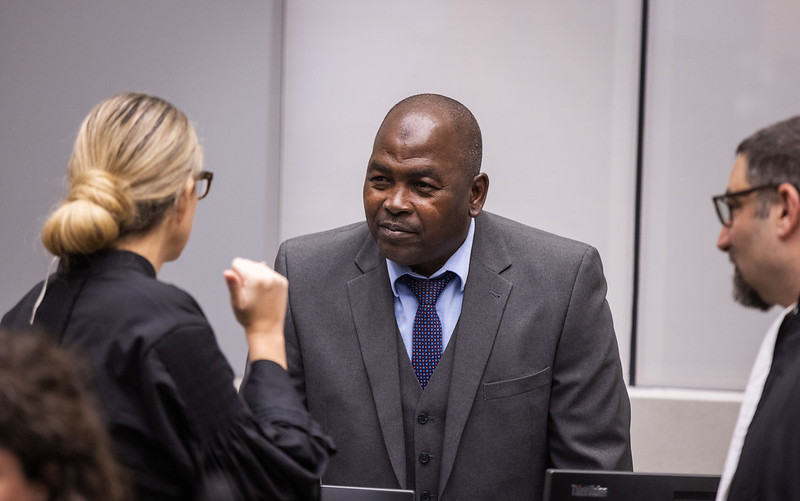
Former Central African Republic (CAR) militia leader Mahamat Said Abdel Kani has been found guilty of crimes against humanity committed in 2013 during civil unrest in the country.
In its judgment on September 23, 2026, the International Criminal Court (ICC) found the former Séléka leader guilty beyond reasonable doubt “for the crimes against humanity of imprisonment or other severe deprivation of physical liberty, torture, persecution and other inhumane acts”, committed at the Office Central de Répression du Banditisme (Central Office for the Repression of Banditry – the OCRB) in the capital, Bangui, between April 12 and August 30, 2013.
ICC Trial Chamber VI found that Kani, whom the ICC identified as the Séléka commander in charge of the OCRB, acted with the required intent and knowledge and was responsible as a direct co-perpetrator of the crimes for which he was convicted.
However, judges, Miatta Maria Samba (presiding), María del Socorro Flores Liera, Sergio Gerardo Ugalde Godínez, and Keebong Paek (alternate), did not find him guilty beyond a reasonable doubt of the war crimes of torture, cruel treatment, and outrages upon personal dignity.
The court found that civilians perceived as supporters of President François Bozizé were targeted and subjected to unlawful arrest, detention, and mistreatment on discriminatory grounds.
“In determining whether an individual may support François Bozizé, the Séléka had regard to a number of indicators, namely an individual’s religion, ethnicity, gender, political background, profession and/or domicile,” the court said, and concluded that the victims were targeted “based on intersecting discriminatory political, ethnic, religious, and/or gender grounds”.
The Office of the Prosecutor welcomed the verdict, saying it was a “significant achievement for the victims, and an end to impunity”.
“Today’s judgment is an important step towards accountability for serious crimes committed in the Central African Republic. It underscores that, through partnership between the court, national authorities and affected communities, those responsible for crimes under the Rome Statute can be brought before the court, irrespective of their position or affiliation. Justice has been delivered through our collective action,” said Acting Prosecutor Mame Mandiaye Niang in a statement.
Accountability for serious crimes
The verdict had been closely followed by civil society organisations working on international justice. Ahead of the judgment, Ali Ouattara, the coordinator of the African Francophone Coalition for the ICC, described the case as “an important step in the fight against impunity in Africa in general and in the Central African in particular.” In a statement on September 17, 2026, he said it also offered an opportunity for CAR victims to obtain compensation for the harm they had suffered.
Kani’s case dates back to the conflict that followed the Séléka coalition’s seizure of Bangui in March 2013 after overthrowing President Bozizé. The conflict was followed by widespread violence involving the Séléka and Anti-balaka armed groups.
The ICC’s case materials say Kani was a senior member of the Séléka coalition and was accused of crimes against people detained at the OCRB, including people perceived to be supporters of Bozizé.
The charges against him were partially confirmed in December 2021, allowing the case to proceed to trial. The ICC had found sufficient evidence at that stage to establish substantial grounds to believe that Kani was responsible for the charged crimes under the Rome Statute.
Kani had seven of the 12 charges that the prosecution had brought against him confirmed against him. These include imprisonment or other severe deprivation of physical liberty as a crime against humanity at the OCRB of persons perceived to be supporters of former president Bozizé between April 12, 2013, and August 30, 2013; and torture as a crime against humanity of people perceived to be Bozizé supporters, who were tied using the arbatachar method (in which a prisoner’s four limbs were tied together behind his or her back), as well as other detainees who were severely mistreated.
The trial opened on September 26, 2022, when Kani pleaded not guilty to all charges. Over the course of 130 trial hearings, the Chamber heard from 58 witnesses called by the prosecution and three called by the defence. The ICC said 3,863 items of evidence were formally admitted into evidence, and 32 victims, represented by their legal counsel, Sarah Pellet, were granted the right to participate in the case.
Delivering the judgment, the presiding judge acknowledged the suffering and trauma of victims who testified about the lasting effects of the crimes on themselves, their families and their lives.
“The persons detained at the OCRB gave evidence that they continue to suffer physical and psychological harm as a result of their detention and abuse,” the ICC said.
ALSO READ: Former Kosovo president gets 25 years for war crimes
The proceedings followed years of investigation into alleged crimes committed during the conflict in CAR.
Led by Michel Djotodia, CAR president between 2013 and 2014, the Séléka was a coalition of previously uncoordinated political factions and armed groups, predominantly Muslim.
Perceived Bozizé supporters
The Séléka used members of the local population to identify the houses of perceived Bozizé supporters, such as retired military men, gendarmes, policemen, civil servants, or relatives. Muslims and Muslim houses were spared.
The Séléka targeted the civilian population based on religious grounds. Christians were considered supporters of the former government. Other affiliations included government employees, ethnicity, Bozizé’s Gbaya tribe, and specific neighbourhoods.
Anti-Balaka leaders Alfred Yekatom and Patrice-Edouard Ngaïssona were also tried before the ICC, arising from the situation in the Central African Republic. They were accused of coordinating attacks against the country’s Muslim population in 2013-14.
Yekatom was surrendered to the ICC on November 17, 2018, while Ngaïssona was arrested by the authorities of the French Republic on December 12, 2018, and transferred to the ICC Detention Centre on January 23, 2019.
On July 24, 2025, Yekatom was found guilty of 20 charges of war crimes and crimes against humanity and was sentenced to 15 years in prison.
Ngaïssona, the former head of the Central African Republic football federation, was found guilty of 28 counts of war crimes and crimes against humanity and was sentenced to 12 years in prison.
CAR referred the situation to the ICC in May 2014, and the Prosecutor opened the second ICC investigation into the country in September that year. The investigation was formally closed in December 2022, while cases arising from it continued through the judicial process.
Kani was surrendered to the ICC on January 24, 2021, after an arrest warrant had been issued against him in January 2019. His confirmation-of-charges hearing took place in October 2021, before the case proceeded to trial the following year.
According to the court’s press release, the prosecution and defence have 30 days to appeal the verdict. The trial chamber will announce the timetable for the sentencing proceedings. A reparation process will also begin for the victims of the crimes for which Kani was convicted.