

One of the tools that made the Gen Z-led protests so successful was their ability to use the digital space to amplify their frustrations with a system of political corruption and economic inequality that conspired to lock them out. Their dexterity in using social media enabled them to interconnect in their own countries and even across borders, to create the momentum that contributed to the success of most of their protests.
It is not surprising that governments and other official agencies would do everything possible to destroy this powerful tool that threatened their authority.
In Kenya, one of the countries that was affected by the mass protests, the authorities soon employed measures to curtail the Gen Z actions. An Amnesty International report released in November 2025 describes how the Kenyan government systematically deployed technology-facilitated violence as part of a coordinated effort to suppress the dissent that burst out during the June 2024 and July 2025 Gen-Z-led protests, leading to many deaths and enforced disappearances.
And now, as the country prepares for the 2027 general elections, that digital assault is only intensifying. Young Kenyans, who have learned a painful lesson from their experiences during the protests, are seeking solutions to keep them safe during the expected turbulent electoral period.
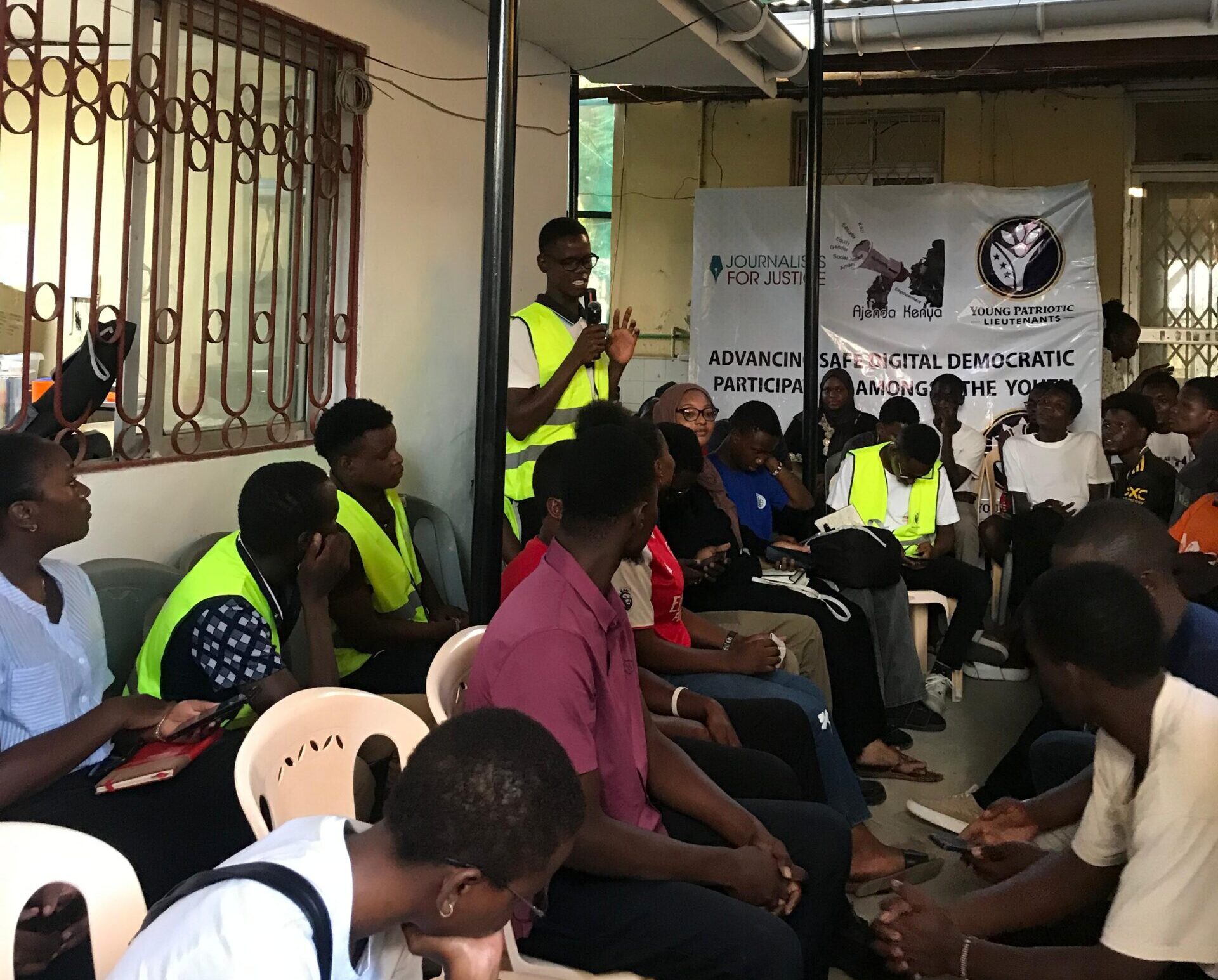
During a recent forum organised through the partnership of Journalists For Justice (JFJ), Ajenda Kenya, and Young Patriotic Lieutenants (YPL), young people gathered to discuss digital literacy and safety.
The young people spoke honestly about the online world that has become both their lifeline and biggest liability. It was an open discussion, the kind where microphones are passed around and nobody holds back. The venue was fitting; Tudor, a residential neighbourhood located in the north of Mombasa Island along the shores of Tudor Creek and home to the Technical University of Mombasa (TUM), is a place that hosts many young people, where unemployment is real, and the smartphone is everyone’s companion.
The conversations cut across two of the most dangerous threats lurking behind the digital façade: digital insecurity and enforced disappearances. And as the general elections loom in August 2027, one of the most common issues raised at the forum was the effect of propaganda in the digital space.
The participants acknowledged the fact that social media has become a weapon pointed squarely at young Kenyans. One participant described how a woman was circulating false claims online that she had refilled a small gas cylinder for KSh800 (about US$6) and that the administration had built 25,000 kilometres of tarmac roads since it took office. This disregards the fact that gas refills cost more than this amount and the number quoted is larger than the country’s total tarmac road network built since its independence more than 60 years ago.
“That is strategic propaganda which can mislead and bring about disinformation and misinformation,” the participant said.
Some of the misleading information sounds almost absurd. Participants argued that this is the objective of putting out such information. Strategic misinformation does not always have to be sophisticated; sometimes it just needs to be repeated loudly enough, and with enough confidence, to be believed.
According to the Reuters Institute Digital News Report 2025, 55 per cent of the Kenyans surveyed identified TikTok as the leading source of false or misleading information in the country, more than any other platform. It said a growing share of people, especially younger, urban, online users, now get their news through TikTok, with 38 per cent of the respondents saying they use the platform for news.
So, how can young people tell what kind of information they are dealing with online?
One participant suggested that before you can fight propaganda, you must first understand the information problem you are facing. This was broken down into misinformation, which is false information shared unknowingly; disinformation, defined as falsehoods spread deliberately; and malinformation, which is entirely true information that is used to cause harm.
“For example, if you leak harmful private medical information online about someone with cancer who is trying to get an elective seat or opportunity, that is malinformation. It can lead to depression, stress, and ultimately to them losing everything,” the participant said.
The link between propaganda and physical danger is not merely rhetorical; it has been documented. Several organisations, including Amnesty International, have spent years tracking exactly how disinformation and impunity intersect in Kenya, from the post-election violence common in earlier years to the digital targeting of activists during the 2024 and 2025 protests. News reports describe how Kenyan youths, mobilised online, have paid with their lives on the streets.
Ryan Nyego, one of the speakers at the Tudor forum, put it in plain language. “Usikue [don’t be a] goon in the digital space. In this election time, usijipate Shakahola.” [Do not end up at Shakahola], referring to Kenya’s recent discovery of the tragic mass murder of members of a religious sect in Shakahola, Mombasa County, whose bodies were buried in unmarked graves.
Odembe Franklin, a TUM student leader, offered what was perhaps the most nuanced take of the evening. “As much as blogging seems like a threat, and indeed comrades have been heavily affected, on the positive side, it has also created employment for many youths. The danger comes when bloggers go to the extreme of dirtying or tarnishing other people’s names.”
He was careful to hold both truths at the same time. “It’s both a good and a bad thing. Politicians often use bloggers to create a fake perspective, paying them to sing their praises that don’t match the reality on the ground. In return, it is the blogger who suffers the consequences when taken to court for defamation.”
Odembe added that blogging can be a trap that young people desperate for money often walk into with open eyes.
Dreda Odiwuor, the Programmes Manager at Ajenda Kenya, described a tool her organisation has developed to deal with disinformation. Maskani Hub operates both as a WhatsApp channel and a dedicated section of the Ajenda Kenya website, combining fact-checking with a digital threat reporting mechanism. Maskani is a Kiswahili word for “home” or “dwelling”.
“We realised that there is a lot of misinformation and malinformation being spread out there,” Odiwuor explained. “We created Maskani Hub to help people to get factual information.”
The WhatsApp channel, launched in early 2026, serves as a community verification desk where content is checked against fact-checking tools, including Africa-focused verification platforms, before it is shared. The website component allows people to report digital threats anonymously. They leave only an email address, and the Ajenda Kenya team can follow up or refer cases to organisations with the capacity to handle them.
In the case of reports involving threats that implicate security agencies, she said, “We collaborate with other organisations that can help us to reach the police directly. We cannot handle such an issue in a linear manner. It involves a lot of consultation so that we also do not harm the person at risk. This is because when we report to the police, the person can be in danger of being disappeared.”
READ ALSO: Violence, legal threats weaponised to undermine freedom and human rights in Kenya
The forum also discussed other common digital threats. Young people were warned to be careful about opening or clicking on links whose origin they do not know. “We have all seen those messages asking you to click on a certain link to get a loan. This is a loan you did not apply for, yet you go ahead and click on the link. This might give a con man access to your e-banking details and photos, which can be stolen,” one participant said. They were also cautioned about using public WiFi, which is often an open door for hackers. “If you must use it, use a VPN, which will veil your location and prevent hacking,” he added.
They were also warned about casual online behaviour that can lead to physical danger. “Be very careful how you use the internet. Do not post just to get followers. Do not share information you are not sure of. Remember the increasing cases of extrajudicial killings and kidnappings. Your online activity can put you in real physical danger.”
The Gen Z protesters have learned the cost of demanding accountability on Kenyan streets. The forum participants were warned not to post their photos or locations during protest marches. They were advised to post them after the demonstration and to switch off the location settings on their social media platforms. They were urged to verify information before sharing it and to ask themselves the question, “Would I say the same thing offline?” before typing anything.
The question of surveillance came up. “How safe are we if there is no privacy?” one participant asked. “The government can silence us through surveillance, monitoring our phone calls, reading our messages, or tracking our social media accounts. That fear alone is a form of control.”
This is not a hypothetical question. In January 2026, the Kenya Human Rights Commission (KHRC) expressed concern at a government proposal to Parliament to establish a digital intelligence unit to monitor online activity. KHRC noted that the regime’s abuse of digital surveillance was on full display during the 2024 Gen Z protests, when young people were tracked, captured, and subjected to what the commission described as “unprecedented atrocities”. By KHRC’s own count, 42 civilians were killed, hundreds of others were injured, and over 1,700 people were arrested in the wake of the protests.
The death of activist blogger Albert Ojwang in police custody in 2025 intensified calls for accountability. Civil society groups, including Article 19 and the Bloggers Association of Kenya, have mounted legal challenges against restrictions on broadcasting and proposed surveillance laws.
The recommendations from the forum included appeals to young people to vote with morality and ethics, to refuse to be used as middlemen in propaganda and misinformation schemes, whether online or on the ground, and to resist being paid to influence others. Bloggers were urged to verify all the information before using it, to be wary of the “Subaru Boys” culture of performative online bravado, and to take responsibility for the consequences of what they publish.
READ MORE: East Africa and the Horn: A region stretched by conflict and repression
The call for caution and safety was serious as it has become abundantly clear that the next election will not be fought at political rallies or on ballot papers alone; it will also be in WhatsApp groups, anonymous posts, and viral claims engineered to manipulate. For the young people of Kenya, understanding the new battlefield is no longer optional; it is at the root of their survival.