

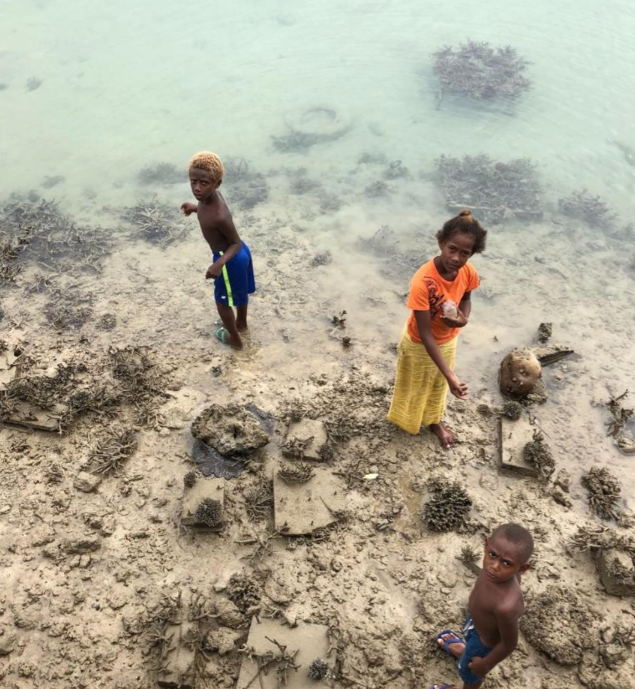
Picture this: Port Vila, May 2019, the perfect beach at midday. Somewhere on the rocks where the water is shallow, a Malenesian 10-year-old girl with bare feet is teaching her younger siblings how to fish. They don’t have fancy equipment; just bottles and fishing line. She picks up a small rock and smashes it on a cluster of clams at her feet. She pulls out an exposed clam, attaches it to a hook and casts the fishing line into the water. Her siblings watch with glee and then pick up some rocks, mimicking their sister.
That was my last day in Vanuatu after a week of diplomatic work, and I couldn’t help but feel small. The people I’d met had touched my heart, and besides feeling grateful, I was also intimidated. Life is so simple in the island nation that it made me reflect deeply on the words “economic development” and the question of “at what cost?” For someone used to the crowded proximity of the continent, the geography was intimidating.
To be surrounded by the vast, deep blue of the Pacific, where the next neighbour is thousands of kilometres away, is to feel both remarkably small and singularly exposed. When I spoke to the staff at my hotel about Cyclone Pam, which devastated the tiny nation in 2015, they spoke of the eerie ritual of preparation: tying the sun chairs together and sinking them to the bottom of the pool or risk turning them into missiles, gathering as much water and food as possible, and preparing to huddle in the dark as the world outside dissolved into a roar. I left Vanuatu with a sense of respect, but more introspectively, of a debt to their resilience, a debt that Nicole Ponce and her peers at World’s Youth for Climate Justice (WYCJ) are now working to collect.
Nicole, also my co-author in this article, represents a generation that has refused to wait for a dream to be handed to them. Together, we see the new UN General Assembly (UNGA) resolution on the advisory opinion of the International Court of Justice (ICJ) on climate change, adopted on May 20, 2026, as the moment the rhetoric of the past three decades (since the first COP in Berlin in 1995) meets the reality of the law. It is less of a diplomatic handshake and more of a reclamation of the decades lost to inertia. The UN resolution formally serves notice to those who have, for a long time, prioritised profit over our collective survival.
In 2019, a group of law students who called themselves Pacific Island Students Fighting Climate Change (PISFCC), approached the Vanuatu government with a radical idea: to take the climate crisis to the world’s highest court, the ICJ. The momentum that followed became a diplomatic juggernaut. By 2022, Vanuatu had formally taken the lead at the United Nations. On July 23, 2025, the ICJ delivered its landmark advisory opinion that changed the legal landscape forever.
Collective obligations to protect the system
The ICJ’s advisory opinion was not revolutionary; it was revelatory. It clarified and reaffirmed states’ obligations under international law. The court was clear: States have collective obligations to protect the climate system, and there can be legal consequences for those who, through their acts or omissions, cause significant harm. But as any lawyer knows, a “clarification of law” is only as good as its enforcement.
Vanuatu did not rest on its laurels. Less than a year after that historic advisory opinion, in February 2026, it pounced again with a new draft UNGA resolution designed to sink its teeth into the ICJ’s findings. If the advisory opinion was the verdict of history and not just some paper tiger, this new resolution will serve as the manual for action. It moves beyond the what and focuses on the how. Specifically, the resolution seeks to do three things to operationalise the advisory opinion.
One, it clarifies that climate action is a matter of implementing existing legal duties with seriousness. It serves as a long-overdue audit of the responsibilities states have held for decades, noting that a breach of these obligations “constitutes an international wrongful act entailing the responsibility of that state”. By listing the specific legal consequences for these wrongful acts, such as the duty to cease the action, provide guarantees of non-repetition, and provide full reparation to injured states in the form of restitution, compensation, and satisfaction, the resolution provides a standardised roadmap for remediation. It effectively moves the needle from political hope to a framework where policies and financing must finally reflect the stringent due diligence required to prevent significant harm.
Second, it bridges the gap between scientific goals and legal obligations. The resolution urges states to implement measures to achieve the 1.5°C temperature goal in keeping with the “best available science”. As part of this obligation, specific actions were listed, such as tripling renewable energy, doubling energy efficiency, and transitioning away from fossil fuels to reach net zero by 2050. By embedding these specific energy targets into a resolution about legal obligations, Vanuatu is helping to define what due diligence actually looks like in 2026. Most importantly, it gives youth activists a specific legal yardstick to measure whether their government’s climate plan is legally “diligent” or “wrongful”.
Third, it ensures that the advisory opinion is not a one-off event by requesting the Secretary General to submit a report during the 81st session of the United Nations General Assembly in September 2026. This report must specifically contain “ways to advance compliance with all obligations” and identify “possible gaps in multilateral efforts”. It creates a recurring compliance check within the UNGA, forcing the legal findings into the permanent diplomatic machinery.
ALSO SEE: UN General Assembly votes yes on Vanuatu proposal on climate change
An authoritative clarification of international law
The climate crisis is accelerating faster than our response. Science has been clear for years, yet political will has lagged, leaving a dangerous gap between what states know and what they do.
By adopting the resolution, the General Assembly has unequivocally welcomed the ICJ advisory opinion as an authoritative clarification of existing international law. It does not create new obligations; rather, it provides a pathway for continued consultation and coordinated action. It translates legal clarity into organised multilateral follow-up. However, clarity alone does not cut emissions, protect communities, or deliver justice. Without coherent and coordinated implementation, even the strongest legal guidance is at risk of being ignored.
The campaign for an advisory opinion before the world’s highest court was the young generation’s call for justice. Vanuatu and the youths have started the ball rolling, but we must realise that it is our collective fight. This resolution is both an opportunity and a duty for governments to respond accordingly – to uphold global cooperation, multilateralism, and the rule of law in addressing the climate crisis.
The vote at the UN General Assembly was a litmus test for the international community: Would the world’s powers accept a framework that holds them to their own promises, or would they look the people in the eye and tell them that the law is only for the powerful? The “greatness of small” brought us to the water’s edge. The passing of the vote now paves the way for the next step of our collective journey of advancing climate justice.
Shirleen Chin is an international legal expert who focuses on matters related to the environment, climate, international (criminal) law, human rights, anti-corruption, and organised crime. Through her consultancy, Green Transparency, she uses her skills and experience in strategic advocacy to support NGOs and other stakeholders in their initiatives.
Nicole Ann Ponce is an environmental and human rights lawyer/advocate from the Philippines. She co-founded World’s Youth for Climate Justice (WYCJ) and serves as its Advocacy Lead. WYCJ is one of the youth-led organisations, together with PISFCC, that were instrumental in securing the historic 2025 advisory opinion of the International Court of Justice on the Obligations of States in Respect of Climate Change.